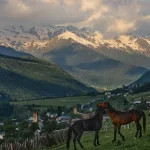
August 2026 in Georgia is genuinely wonderful — but only if you go in knowing what you’re walking into. Temperatures in Tbilisi regularly hit 38°C, coastal Batumi is packed to its limits, and mountain roads to Kazbegi can see serious congestion every weekend. None of that should stop you from coming. It just means you need to plan smarter than the average tourist who books flights, shows up in the midday sun, and wonders why they feel terrible by day two.
The Heat Reality: What August in Georgia Actually Feels Like
Tbilisi in August is dry and fierce. The city sits in a basin surrounded by hills that trap heat, and by noon the pavements along Rustaveli Avenue radiate warmth you can feel through the soles of your shoes. Temperatures between 35°C and 40°C are completely normal, and the occasional day pushes past that. The old city — Abanotubani and the alleys around Narikala — gets slightly better air movement, but not much.
That said, mornings are genuinely pleasant. Between 7am and 10am, the city is cool enough to walk comfortably, the light is golden, and the streets belong mostly to locals heading to work. This is the window when serious sightseeing happens. By 11am, the sensible move is to find shade, a cold Natakhtari lemonade, and somewhere to sit until around 5pm when the heat starts to break again.
Batumi on the Black Sea coast sits at around 28–33°C in August, but it’s humid. The combination makes it feel heavier than Tbilisi’s dry heat. The beach is where most visitors spend the afternoon hours, which is perfectly reasonable — the sea temperature sits comfortably around 26°C in August, warm enough to stay in for a long time.
Above 1,500 metres in the Greater Caucasus, August is a different world entirely. Kazbegi at roughly 1,750 metres sits at around 18–24°C during the day, dropping to as low as 8–10°C at night. If you are heat-sensitive or travelling with young children, the mountains are not just scenic — they are a genuine relief from the lowland summer.
Where the Crowds Go — and Where They Don’t
The honest truth is that Georgia’s most famous destinations in August are genuinely crowded. Gergeti Trinity Church above Stepantsminda sees a constant stream of hikers from dawn onwards. The monastery itself is small, and the trail is busy enough that some mornings feel more like a queue than a hike. The view is still extraordinary — the church perched against the snow-capped face of Mount Kazbek at 5,047 metres is one of the most dramatic sights in the Caucasus — but managing your expectations helps.
Mestia in Svaneti is similar. The town itself has expanded its tourism infrastructure steadily over the past few years, and August means full guesthouses, busy restaurants, and the constant sound of 4×4 vehicles heading up the valley. The Ushguli day trip from Mestia — one of the highest continuously inhabited settlements in Europe — is best done by leaving Mestia before 8am to beat the convoys.
Where the crowds thin out considerably:
- Tusheti — Accessible only via the Abano Pass, one of the most dramatic mountain roads in the region, Tusheti sees far fewer visitors than Kazbegi or Svaneti purely because the road demands either a serious 4×4 or a hired local driver. The villages around Omalo are calm, genuinely remote, and stunningly beautiful in August.
- Borjomi-Kharagauli National Park — Well-established hiking infrastructure, cool forested trails, and far lighter tourist pressure than the Caucasus highlights.
- Lagodekhi Protected Areas — In the far east of Kakheti near the Azerbaijan border, these trails offer proper wilderness without a crowd in sight.
August Festivals and Cultural Moments
August is one of Georgia’s richest months for outdoor events, and several of these are long-established enough to plan around with confidence.
Mariamoba falls on 28 August every year — the Feast of the Assumption of the Virgin Mary, one of the most significant days in the Georgian Orthodox calendar. In Tbilisi, Mtskheta, and villages across the country, this is a day of processions, church services, and community gatherings. Mtskheta, the ancient capital about 20 kilometres north of Tbilisi, is particularly atmospheric on this day. The crowds are Georgian families, not tour groups, and the feeling is of a country marking something that genuinely matters to it.
The Tbilisi Open Air festival has been a fixture of the city’s summer cultural calendar for years. Held at various outdoor venues around the city, it typically brings together Georgian and international electronic music acts across August weekends. The exact 2026 programme should be confirmed closer to the time via the organisers’ official channels, but the event has run consistently and is a good reason to choose a weekend in late August if nightlife and music are part of your trip.
In Kakheti — Georgia’s primary wine region about 100 kilometres east of Tbilisi — August is the final quiet month before Rtveli, the grape harvest, which begins in September. Visiting a family winery in August means the vines are heavy and green, the qvevri cellars are cool and fragrant, and the family has time to sit with you. September is more famous, but August is when you get actual hospitality rather than a production line.
Eating and Drinking in August
Georgian summer food is its own category. The heavy winter staples — thick bean soups, dense khinkali broths — give way to something lighter and more alive. Markets in August are stacked with tomatoes so ripe they split at a touch, cucumbers that snap cleanly, and peaches from Racha that smell the way peaches are supposed to.
The dish that defines August eating in Georgia is nigvziani badrijani — thin slices of fried aubergine rolled around a walnut, garlic, and herb paste, served cold. It’s on almost every table at an outdoor supra (feast), and the version you eat sitting under a vine-covered pergola in a Kakhetian courtyard, with a clay jug of chilled amber wine sweating in the August heat, is one of those food memories that stays with you.
Cold wine is important to mention specifically. Georgian amber wines — made from white grape varieties fermented on their skins — hold up better in heat than you might expect. They are fuller-bodied than conventional whites but refreshing in a way that light red wine is not. A chilled glass of Rkatsiteli from the jug at a roadside restaurant in Sighnaghi, with a plate of cold vegetables and fresh bread, costs very little and is one of the simple pleasures August in Georgia does exceptionally well.
2026 Budget Reality: What August Actually Costs
August is Georgia’s peak tourist season, and prices reflect that — particularly for accommodation. Here is an honest breakdown of what to expect in 2026.
Accommodation (per night)
- Budget — Hostel dorm beds in Tbilisi: 40–70 GEL. Guesthouse room in a mountain village: 60–100 GEL including breakfast.
- Mid-range — Private room in a Tbilisi guesthouse or small hotel: 150–250 GEL. Decent hotel in Batumi or Sighnaghi: 200–320 GEL.
- Comfortable — Boutique hotel in Tbilisi old town: 350–600 GEL. Resort-style options in Batumi: 500–900 GEL.
Food and Drink (per person)
- Budget — A full meal at a neighbourhood canteen (stolovaya-style): 15–25 GEL. Street khinkali (five dumplings): 8–12 GEL.
- Mid-range — Dinner at a sit-down restaurant in Tbilisi with wine: 60–120 GEL.
- Comfortable — A tasting menu at one of Tbilisi’s better restaurants: 180–300 GEL with wine pairing.
Transport
- Tbilisi metro or bus: 1 GEL per trip (same as established fare).
- Marshrutka (minibus) Tbilisi to Kazbegi: approximately 15–20 GEL one way.
- Shared taxi Tbilisi to Sighnaghi: approximately 30–40 GEL.
- Private car hire with driver for a full-day mountain trip: 200–400 GEL depending on destination and negotiation.
Getting Around in August: Logistics That Matter
The Tbilisi–Kazbegi road (the Georgian Military Highway) is the country’s single most congested tourist route in August. Friday afternoons and Saturday mornings heading north, Sunday evenings heading back — these windows can mean journey times of four hours or more for what is normally a two-hour drive. If you can travel mid-week, the difference is dramatic.
Georgian Railway runs regular services between Tbilisi and Batumi, and between Tbilisi and Kutaisi. These trains are air-conditioned, reliable, and a genuinely comfortable way to move between cities without dealing with summer road traffic. Book tickets in advance through the Georgian Railway website — August seats on popular departure times sell out.
For Tusheti, Svaneti, and other remote mountain areas, hiring a local driver with a suitable vehicle is the standard and sensible approach. Attempting these roads in a standard rental car is a real mistake — road conditions vary, and your rental agreement is likely to prohibit it anyway.
Tbilisi’s public transport — metro, buses, and the cable car to Narikala — runs normally throughout August and is one of the most affordable ways to navigate the city. The metro is air-conditioned and a genuine relief during the midday heat.
Explore more
Georgia’s Mountain Retreats: Your August 2026 Guide to Cooler Escapes
Batumi’s Summer Charm: Your July 2026 Guide to the Black Sea Gem
Beating the Heat: Essential Tips for Visiting Georgia in July 2026
📷 Featured image by Aditya Parikh on Unsplash.