On this page
- Why Mtskheta Works So Well for Families in 2026
- How Kids Actually Experience the Old Churches
- The Best Outdoor Spaces and Walking Routes for Families
- Where to Eat with Children in Mtskheta
- Hands-On and Interactive Experiences Kids Will Remember
- Getting to Mtskheta with Kids in 2026
- What to Buy: Kid-Friendly Souvenirs and Market Browsing
- Practical Family Tips: Strollers, Timing, and What to Pack
- 2026 Budget Breakdown for a Family Day Trip to Mtskheta
- Frequently Asked Questions
💰 Click here to see Georgia Budget Breakdown
💰 Prices updated: August, 2026. Budget figures are estimates — always verify before travel.
Exchange Rate: $1 USD = ₾2.61
Daily Budget (per person)
Shoestring: ₾80.00 – ₾170.00 ($30.65 – $65.13)
Mid-range: ₾150.00 – ₾420.00 ($57.47 – $160.92)
Comfortable: ₾650.00 – ₾1,200.00 ($249.04 – $459.77)
Accommodation (per night)
Hostel/guesthouse: ₾25.00 – ₾50.00 ($9.58 – $19.16)
Mid-range hotel: ₾80.00 – ₾200.00 ($30.65 – $76.63)
Food (per meal)
Budget meal: ₾20.00 ($7.66)
Mid-range meal: ₾40.00 ($15.33)
Upscale meal: ₾100.00 ($38.31)
Transport
Single metro/bus trip: ₾1.00 ($0.38)
Monthly transport pass: ₾40.00 ($15.33)
Why Mtskheta Works So Well for Families in 2026
Most parents traveling to Georgia in 2026 face the same quiet anxiety: is a UNESCO heritage city actually fun for a six-year-old? Tbilisi’s cable cars and playgrounds are obvious family wins, but Mtskheta — Georgia’s ancient former capital, just 20 kilometres north of Tbilisi — often gets dismissed as a place for history lovers with no children in tow. That assumption is wrong, and it’s costing families one of the best half-day trips on the entire Caucasus circuit.
Mtskheta is compact, walkable, and visually dramatic in ways that children respond to instinctively. Fortress walls rise above river confluences, monasteries perch on clifftops like something from a storybook, and the streets are narrow enough to feel like an adventure rather than a tourist conveyor belt. The whole old town can be covered on foot without anyone — adult or child — feeling overwhelmed. At under 30 minutes from Tbilisi by train, it’s also the lowest-effort big-reward excursion the country offers.
How Kids Actually Experience the Old Churches
Let’s be honest: most children under ten don’t care about 5th-century ecclesiastical architecture. But Svetitskhoveli Cathedral — the great pillared church that dominates the centre of Mtskheta — has something working in its favour that no amount of parental explanation can manufacture: sheer physical scale. Walking through the cathedral gate and looking up at stone walls that have stood for over a thousand years produces a genuine reaction in kids. It’s big, it’s old, and it smells faintly of incense and cool stone in a way that registers differently from anything at home.
Inside, the frescoes are vivid and figurative — dragons, angels, soldiers, saints — and children often engage with them the way they would a picture book, pointing and asking questions without any adult prompting. The story of the dragon slain by Saint George, which appears repeatedly in Georgian church iconography, is one that translates immediately to young imaginations. Frame the visit as a “find all the dragon pictures” challenge before you go in and you’ll buy yourself a solid twenty minutes of genuine engagement.
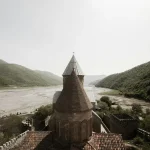
Jvari Monastery, perched on the hill overlooking the confluence of the Mtkvari and Aragvi rivers, is best approached as a visual experience rather than an interior one — the church interior is small — but the panoramic view from the terrace is genuinely arresting for children who have any interest in rivers, hills, or the simple fact of being very high up. The stone terrace is wide and safe, and on a clear day you can see the curve of the Aragvi snaking down from the north. The 5-minute drive up from Mtskheta town adds a mini-adventure quality to the visit.
The Best Outdoor Spaces and Walking Routes for Families
The riverfront area along the Mtkvari is Mtskheta’s best-kept family secret. A flat, paved embankment path runs along the water’s edge south of the old town, and in 2026 this stretch has been tidied up with additional benches and low railings that make it genuinely pushchair-accessible for most of its length. In the morning hours it’s quiet enough for toddlers to run without being crowded, and the view across the water to the hills keeps adults engaged while children do whatever children do near rivers.
The walk between Svetitskhoveli Cathedral and the old town market area takes about ten minutes at a child’s pace and passes through a street of small stone buildings, a few garden walls draped in vines, and usually at least one dozing cat on a step — which, in the experience of most parents, is worth more entertainment value than the cathedral itself. The streets are largely flat and surfaced, though some of the lanes closer to the cathedral have uneven cobbles that make a stroller more of a burden than a help.
For families with older children — roughly eight and up — the walk up through the old town to the remains of the Bebris Tsikhe fortress takes about 20 minutes and rewards with a solid view over the rooftops and the river below. It’s not a maintained tourist trail, but it’s safe and the ruins themselves are interesting precisely because they’re unpolished: rough stone walls you can actually touch, with no ropes or barriers keeping children at a distance.
Where to Eat with Children in Mtskheta
The restaurant strip running along the main pedestrian street approaching Svetitskhoveli is built almost entirely for day-tripping groups, which means the kitchens are fast, the menus are picture-heavy, and tables turn over quickly — all useful qualities when you’re eating with hungry, restless children. Most places set out long wooden tables under vine-covered pergolas, and the shade is welcome in summer when temperatures in Mtskheta regularly hit 30°C or above.
The standard family order at any of these restaurants works well: a plate of fresh-baked shoti bread that arrives hot and pulling apart in long fibrous strips, which children eat like breadsticks while the adults order properly. Khinkali — the soup dumplings — are universally popular with children who can handle the novelty of eating with their hands and drinking broth from a parcel of dough. The trick is ordering a mix of meat and mushroom fillings so there’s something for every eater at the table. A meal for a family of four at a mid-range restaurant on the main strip runs to 80–130 GEL including soft drinks.
For something quicker and cheaper, the small vendors near the market entrance sell churchkhela (the walnut-and-grape-juice candy sticks that look extraordinary and taste like concentrated dried fruit) and fresh fruit in season. Children who haven’t tried churchkhela before are usually fascinated by its appearance — it genuinely looks like a candle or a medieval weapon — which does half the selling work before anyone takes a bite.
One practical note: high chairs are available at the larger restaurants on the main strip but are not universal across smaller cafes. If you’re traveling with a child under two who needs one, check when you’re being seated rather than after you’ve ordered.
Hands-On and Interactive Experiences Kids Will Remember
The Mtskheta area has a small but growing set of hands-on experiences that go beyond looking at old stones. The most family-relevant in 2026 is a pottery workshop run out of a courtyard studio on the edge of the old town, where a local ceramicist offers 45-minute drop-in sessions for children and adults together. The focus is on traditional Georgian clay-work forms, and children as young as five can manage the basic pinch-pot technique. Sessions cost around 25–35 GEL per person and finished pieces can be collected or shipped. It’s worth calling ahead to confirm availability, as the studio operates on informal hours outside of peak season.
The outdoor market near the main car park is worth treating as an experience rather than just a shopping stop. Vendors sell everything from amber jewellery to Soviet-era coins to handmade wooden toys, and children with any magpie instincts will find it completely absorbing. Give older children a small budget — 10 or 15 GEL — and let them negotiate for something themselves. Georgian vendors are generally warm with children, and the interaction itself becomes a memory.
If you’re visiting in late September or October, the Rtveli harvest season means that local estates within a short drive of Mtskheta sometimes open their vineyards for grape-treading days. These are not formal tourist events — they’re working harvests — but families who ask locally or through their guesthouse can often join in for an afternoon. Children love the physical absurdity of stomping grapes, and the purple-stained legs are a reliable bath-time story for weeks afterward.
Getting to Mtskheta with Kids in 2026
The Georgian Railway commuter service from Tbilisi’s main station (Tbilisi Central) to Mtskheta runs regularly throughout the day in 2026, with the journey taking approximately 20 minutes. The fare is 1 GEL per adult; children under five travel free. The carriages are not luxurious but they’re clean, and the short duration means even restless toddlers can handle it. The Mtskheta train station sits about 1.5 kilometres from the old town centre — a flat walk of 15–20 minutes, or a quick taxi for 5–8 GEL if anyone’s legs are already flagging.
By car or taxi from Tbilisi, the trip runs 25–35 minutes depending on traffic. A round-trip taxi from central Tbilisi, including a couple of hours of waiting time while you explore, typically costs 60–90 GEL negotiated in advance. Bolt and Yandex Go both operate this route and give you a metered fare with no negotiation required, which many families find easier with children in tow.
Marshrutka (shared minibus) services from Didube station in Tbilisi are the cheapest option at around 1.50 GEL per person, and they drop passengers in the centre of Mtskheta, but the vehicles are cramped and don’t have seatbelts in the rear — not ideal for families with young children. The train or a private car is the better call for a family group.
Parking in Mtskheta itself is available near the main market area and is free of charge, making it straightforward for families arriving by rental car from Tbilisi.
What to Buy: Kid-Friendly Souvenirs and Market Browsing
The outdoor market running parallel to the approach to Svetitskhoveli is the best souvenir stop in Mtskheta, partly because prices are lower than in Tbilisi’s tourist-facing shops and partly because the range is genuinely broad. For children, the most useful buys are the small painted wooden toys (animals, trucks, spinning tops) that several vendors sell from low tables at child eye-level — pricing starts at 5 GEL and most things sell for 10–20 GEL. Handmade felt ornaments are lightweight, durable, and cheap enough that losing one in the bottom of a bag doesn’t cause a crisis.
Churchkhela in various nut and grape combinations makes a practical edible souvenir that survives the journey home. The best quality comes from vendors who make it themselves rather than buying in bulk — look for strings where the coating is slightly irregular and matte rather than glossy, which indicates home production.
For older children with specific interests, the Soviet-era coin and badge sellers near the car park entrance are worth a look. A small collection of old Georgian coins costs almost nothing and makes for an excellent talking point at school. The vendors are usually willing to explain the origins of individual pieces, and several speak enough English in 2026 to have a basic conversation with a curious ten-year-old.
Practical Family Tips: Strollers, Timing, and What to Pack
A lightweight umbrella stroller rather than a full travel system is the right call for Mtskheta. The main pedestrian street and embankment path are manageable, but the cobbled lanes closer to Svetitskhoveli will challenge anything with small wheels. If your child is over three and can walk independently, leaving the stroller at the accommodation is genuinely easier.
Timing matters more than most family travel guides admit. Mtskheta gets crowded with coach tours from Tbilisi between 11:00 and 14:00. Arriving by 9:30 and being done by 12:30 puts you in the city before the crowds and back in Tbilisi for an afternoon nap before the crowds hit the cathedral in force. Alternatively, arriving after 15:00 as the day-trippers leave also works well — the light is better for photographs in the late afternoon, and the streets quiet down noticeably.
Sun protection is non-negotiable between May and September. The old town has limited shade and the stone surfaces reflect heat intensely. A hat, sunscreen, and a water bottle per person are minimum requirements — the sensory reality of Mtskheta in July is the press of hot stone against your palm and the smell of baking dust rising from the cobbles as the afternoon temperature peaks. It’s beautiful, but it’s also genuinely hot.
Most of the restaurants and larger shops have toilet facilities, but clean public toilets are limited. The best option is to use the facilities at whatever restaurant you eat at. Some sites charge 0.50–1 GEL for toilet access.
2026 Budget Breakdown for a Family Day Trip to Mtskheta
Mtskheta is one of the most affordable family day trips available from any major city in the region. The following figures are based on 2026 pricing for a family of two adults and two children.
- Transport (train, round trip): 4 GEL total (2 adults at 1 GEL each, 2 children under 5 free) or 8 GEL if both children are over 5
- Transport (private taxi, round trip with wait): 60–90 GEL
- Svetitskhoveli Cathedral entry: 3 GEL per adult; children under 18 free
- Jvari Monastery entry: Free of charge in 2026
- Lunch at a mid-range restaurant (family of four): 80–130 GEL
- Street snacks and churchkhela: 15–25 GEL
- Pottery workshop (per person): 25–35 GEL
- Souvenirs and market browsing: 20–50 GEL depending on what you buy
Budget family day trip total (train transport, basic food, no workshop): approximately 120–150 GEL
Mid-range family day trip (taxi, sit-down lunch, some souvenirs): approximately 220–280 GEL
Full experience (taxi, workshop, good lunch, generous souvenir budget): approximately 350–430 GEL
These figures make Mtskheta genuinely accessible even on a tight travel budget, particularly when compared to equivalent heritage day trips from Tbilisi with more significant entry fees or longer, costlier transport.
Frequently Asked Questions
Is Mtskheta suitable for toddlers and very young children?
Yes, with realistic expectations. The main attractions are outdoors and walkable, the train journey is short, and the restaurants are casual and family-tolerant. The cobbled lanes near Svetitskhoveli make strollers awkward, so a baby carrier is a better option for children under two. Plan around nap schedules and you’ll have a smooth visit.
How long should families spend in Mtskheta?
A half-day of three to four hours is enough to cover Svetitskhoveli, the market, lunch, and a walk to Jvari. Families with older children who want to add the fortress ruins or a pottery workshop should budget five to six hours. Staying for a full day risks running out of things to do in the afternoon, particularly with young children.
Are there entry fees at the main sites, and are children charged?
Svetitskhoveli Cathedral charges 3 GEL for adults in 2026. Children under 18 enter free. Jvari Monastery has no entry charge. The Samtavro Monastery complex, a smaller but worthwhile site in the north of town, also charges a small fee for adults, with children free. Overall, site costs for a family are minimal.
What is the best age range for a Mtskheta visit with children?
Children aged five to twelve tend to get the most from Mtskheta. The visual drama of the churches, the freedom of the market, and the storybook quality of the hilltop monastery all land well in that age bracket. Teenagers with an interest in history or photography often enjoy it too. Under-fives can have a great time but benefit most from the outdoor and river areas rather than the interiors.
Can you combine Mtskheta with another destination in a single day from Tbilisi?
Mtskheta pairs well with Gori (Stalin’s birthplace, about 75 kilometres further west) if you have a car, but that’s a full and tiring day for young children. A more manageable combination is Mtskheta in the morning followed by the Tbilisi Open Air Ethnographic Museum in the afternoon — both compact, both visually engaging for children, and both reachable without significant driving.
📷 Featured image by EastBridge Think Lab on Unsplash.