On this page
- The Quiet Corners of Mtskheta Town
- Ancient Sites Beyond Jvari and Svetitskhoveli
- Where Locals Actually Eat and Drink
- The Mtkvari and Aragvi Riverbanks
- Hidden Workshops and Artisan Alleys
- Getting to Mtskheta and Moving Around Without a Tour Bus
- Day Trips from Mtskheta Almost Nobody Takes
- Best Time to Visit for Fewer Crowds and Better Light
- 2026 Budget Breakdown
- Frequently Asked Questions
💰 Click here to see Georgia Budget Breakdown
💰 Prices updated: August, 2026. Budget figures are estimates — always verify before travel.
Exchange Rate: $1 USD = ₾2.61
Daily Budget (per person)
Shoestring: ₾80.00 – ₾170.00 ($30.65 – $65.13)
Mid-range: ₾150.00 – ₾420.00 ($57.47 – $160.92)
Comfortable: ₾650.00 – ₾1,200.00 ($249.04 – $459.77)
Accommodation (per night)
Hostel/guesthouse: ₾25.00 – ₾50.00 ($9.58 – $19.16)
Mid-range hotel: ₾80.00 – ₾200.00 ($30.65 – $76.63)
Food (per meal)
Budget meal: ₾20.00 ($7.66)
Mid-range meal: ₾40.00 ($15.33)
Upscale meal: ₾100.00 ($38.31)
Transport
Single metro/bus trip: ₾1.00 ($0.38)
Monthly transport pass: ₾40.00 ($15.33)
In 2026, Mtskheta sits just 20 kilometres north of Tbilisi on every standard tour itinerary — which means it also sits at the centre of a daily traffic jam of minibuses, selfie sticks, and rushed lunch stops. Most visitors spend 90 minutes here, tick off Svetitskhoveli and Jvari, eat a mediocre khinkali near the bus parking lot, and leave. That’s a shame, because the town and its surroundings contain some of the most quietly remarkable corners in the South Caucasus. This guide is for the people who want to stay longer, look harder, and actually feel the age of the place.
The Quiet Corners of Mtskheta Town
The main pedestrian street, Davit Aghmashenebeli, fills up fast on summer mornings. Walk half a block off it in any direction and the crowd disappears almost completely. The residential lanes running west toward the old city wall remnants are where Mtskheta’s actual daily rhythm plays out — old men on plastic chairs outside metal gates, fig trees pushing through cracked stone fences, the sound of a television through an open kitchen window.
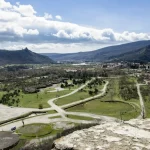
One spot almost no day-tripper finds is the small park area near the confluence of the old walls at the northwestern edge of town. There’s no sign pointing to it. The ground is uneven, the grass is overgrown in places, and scattered stone blocks suggest foundations that haven’t been formally excavated. It doesn’t look like a tourist attraction — and that’s exactly why it feels authentic.
The covered market building at the edge of the town square is worth walking through even if you’re not buying anything. In the mornings before 10:00, local vendors set up with produce from surrounding villages — bundles of tarragon, jars of homemade tkemali, churchkhela made with walnuts from the hills rather than the dyed-red tourist versions sold on the main street. The smell of dried herbs and fresh bread here is sharper and more alive than anything on the souvenir strip.
Ancient Sites Beyond Jvari and Svetitskhoveli
Jvari and Svetitskhoveli deserve their reputation. But treating them as the only ancient sites in the area means missing a radius of sacred architecture that spans more than fifteen centuries.
Samtavro Monastery
Samtavro sits at the northern edge of town, barely five minutes on foot from Svetitskhoveli, and a significant portion of day visitors never walk to it. The complex includes the 11th-century Transfiguration Church, a much smaller earlier chapel attributed to St. Nino, and a functioning nunnery. The nuns still conduct services here in Georgian. If you visit on a Sunday morning, the chanting carries through the courtyard in a way that makes the stone walls feel like they’re vibrating. The grave of King Mirian III and Queen Nana — Georgia’s first Christian monarchs — is inside the main church.
Shio-Mgvime Monastery
This is the one that genuinely surprises people. Shio-Mgvime is about 12 kilometres west of Mtskheta, carved into a limestone gorge above the Mtkvari River. The monastery dates to the 6th century and is still an active community. The road to it is a rough track through a dry, almost semi-arid landscape that feels nothing like the green slopes around Jvari. The cave cells carved into the cliff face above the church are partially accessible and give a visceral sense of how the early monks actually lived — cramped, isolated, cold in winter. Getting there requires a car or taxi; no public transport runs this route.
Bebristsikhe Fortress
Perched on the cliff directly above the confluence of the Mtkvari and Aragvi rivers, Bebristsikhe is the fortress that guards Mtskheta from above and is visible from almost anywhere in town — yet the trail up to it is used almost exclusively by locals taking an evening walk. The ruins are substantial: sections of curtain wall, a tower, and foundations of internal buildings. The view from the top down onto the confluence and across to Jvari on its opposing hill is one of the best unrehearsed panoramas in this part of Georgia. The climb takes about 20 minutes from the town side.
Where Locals Actually Eat and Drink
The restaurants lining Davit Aghmashenebeli cater almost entirely to tour groups and are priced and portioned accordingly. The food isn’t bad, but it’s been smoothed out for mass consumption. The places worth eating at are either tucked into side streets or clustered closer to the residential northern end of town.
There’s a small cluster of simple family-run eateries near the Samtavro end of town where you’ll rarely hear a language other than Georgian spoken by other customers. The menus are handwritten or simply recited. The lobiani here — flatbread stuffed with spiced kidney beans — comes from a wood-fired oven and has the slight char and yeasty pull that the tourist-strip versions rarely achieve. Prices at these spots run roughly 8–15 GEL for a main.

For wine, the serious local choice is not the souvenir shops selling Mukuzani by the bottle. There are a couple of informal wine bars operating out of converted residential spaces near the western lanes where the owners pour from their own or their neighbours’ production — natural, skin-contact wines in unmarked bottles with handwritten labels. You won’t find them on any app. You find them by asking at the market or noticing a handwritten sign on a gate.
The small bakery-café near the town’s main square — not the tourist-facing one with the branded signage, but the one a lane behind it — opens at 07:00 and sells hot bread, gozinaki, and strong coffee. By 08:30 it’s full of locals before work. By 11:00 the tour groups have found it and the energy changes entirely.
The Mtkvari and Aragvi Riverbanks
The confluence of the Mtkvari (Kura) and Aragvi rivers below Mtskheta is one of the most photographed spots in Georgia — and one of the least walked. Almost every image of it is taken from Jvari above. Almost nobody actually goes down to the water level.
A rough path descends from the town’s eastern edge to the riverbank. The confluence itself, where the green-grey Aragvi meets the browner Mtkvari, is visible as a distinct colour line in the water that takes several hundred metres to fully merge. Standing at the bank in the late afternoon, when the light drops low and both rivers reflect different shades of gold, is a genuinely still experience — the kind of thing that photographs can’t quite capture because the stillness is partly sonic: moving water, no traffic, occasional kingfisher.
Walking south along the Mtkvari bank toward the old Pompeii Bridge ruins takes about 30 minutes on a path that’s clear in summer but requires waterproof boots after rain. This walk is used by local fishermen and almost nobody else. The Roman-era bridge abutments still visible in the water are remarkable simply for the fact that almost no one stops to look at them.
Hidden Workshops and Artisan Alleys
Mtskheta has been a craft town for centuries, and while the main street is dominated by mass-produced replicas and Turkish-made souvenirs, the working craftspeople are still here — just not on the front street.
The town has a small concentration of goldsmiths and silversmiths working in a tradition directly descended from ancient Iberian court jewellery. A few of them operate out of workshops in the residential lanes north of the main square, where the workshop is the front room of their house. The enamel cloisonné work produced here — small icons, pendants, earrings with geometric patterns drawn from the Svetitskhoveli carvings — is the real thing. Prices range from 80 GEL for a small piece to several hundred for larger commissioned work. The key is finding them: ask at the Samtavro monastery shop, where the nuns often stock pieces from local artisans and can point you toward workshops.
There’s also a small community of icon painters working in the traditional Georgian egg-tempera method. Unlike the mass-produced icons sold everywhere in tourist Georgia, these are made slowly, on prepared board, using methods that haven’t changed significantly since the medieval period. Some painters sell directly from their studios; others sell through the monastery. Either way, a small original icon starts at around 150–200 GEL.
The churchkhela makers worth finding are not on the main strip. The best ones operate from home workshops in the side streets and use the traditional method of multiple dips in concentrated grape must (tatara) without added sugar or dye. The result is darker, less sweet, and has a slightly bitter grape-skin finish that the bright-red tourist versions completely lack.
Getting to Mtskheta and Moving Around Without a Tour Bus
In 2026, marshrutka minibuses from Tbilisi’s Didube terminal to Mtskheta run frequently throughout the day and cost 1.50 GEL per person. The journey takes 25–35 minutes depending on traffic. This is by far the most practical way to arrive independently and it drops you at the entrance to the town rather than at a tour group parking area.
The Tbilisi metro’s red line extension, completed in 2025, now terminates closer to the Didube bus station, making the connection from central Tbilisi faster. From Rustaveli metro station to Didube takes under 10 minutes.
Within Mtskheta itself, the town centre is small enough to walk entirely. Getting to Shio-Mgvime or up to Jvari requires a car or taxi. Local taxis gather near the market area and the main square. A return trip to Shio-Mgvime, including waiting time, should cost 40–60 GEL negotiated in advance. For Jvari, the standard rate is 15–20 GEL return from the town centre. Ride-hailing apps including Bolt and Yandex both operate here, though coverage can be slower than in Tbilisi.
Cycling from Tbilisi to Mtskheta along the river road has become more popular since the partial completion of a riverside cycling path in 2025. The route is roughly 22 kilometres from Tbilisi’s Didgori bridge area and takes about 90 minutes at a casual pace. Some sections are still on the main road shoulder, so this is better suited to confident cyclists.
Day Trips from Mtskheta Almost Nobody Takes
Zedazeni Monastery
Most people who know Mtskheta well consider Zedazeni the most undervisited site in the entire area. It sits on the ridge directly above and behind Jvari, about 8 kilometres by road from Mtskheta. The monastery was founded in the 6th century by Abba John of Zedazeni, one of the Thirteen Syrian Fathers who helped establish organised monasticism in Georgia. The building itself is modest. The setting is extraordinary — a wide, wind-exposed plateau with views stretching across the Caucasus foothills in every direction. In autumn the surrounding forest turns a deep copper and amber. No tourist infrastructure, no café, no entrance fee. Getting there requires a car or a long uphill walk (about 2 hours on foot from Jvari).
Armazi Archaeological Zone
The ruins of Armazi — capital of the ancient Iberian kingdom — are spread across a plateau just south of Mtskheta near the village of Bagineti. This was one of the most significant urban centres in the ancient South Caucasus. Almost nothing has been done to develop it for visitors, which means you walk among exposed foundations, column stumps, and cut-stone walls with almost no interpretation and nobody else around. The site is accessible by car via a dirt track. Bring water and good shoes.
The Saguramo Ridge Walk
The ridge northeast of Mtskheta, within the Saguramo Nature Reserve, offers a half-day walking route with panoramic views back toward the town, the confluence, and the Greater Caucasus range. The reserve entrance is about 15 kilometres from Mtskheta by road. The trail system is simple but not heavily marked. This is a genuine nature walk with forest, open ridge, and likely sightings of wildlife including deer and raptors. Best done in spring or autumn.
Best Time to Visit for Fewer Crowds and Better Light
Summer (June–August) brings the highest visitor numbers and the most uncomfortable midday heat — frequently above 35°C in the valley. Tour groups run all day. The light is harsh between 10:00 and 17:00.
The shoulder seasons are genuinely different here. April and May bring green hills, wildflowers on the Zedazeni plateau, and comfortable temperatures between 15°C and 22°C. Weekday mornings in April can feel like a completely private visit even to Svetitskhoveli.
October is probably the single best month. The vine leaves on the hills turn gold and red, the harvest activity in nearby villages creates a particular energy, temperatures sit between 12°C and 20°C, and the low-angle afternoon light on the carved stone of the cathedral is extraordinary — warm and directional in a way that summer’s overhead sun never achieves.
November to February is cold (0°C to 8°C, occasionally below freezing) but the crowds almost entirely disappear. Mtskheta in a light snowfall, with smoke coming from chimneys in the residential lanes and the cathedral stone darkened by moisture, is a different place entirely from the summer tourist version.
2026 Budget Breakdown
Mtskheta is generally cheaper than Tbilisi for food and accommodation, though some tourist-facing restaurants have raised prices significantly since 2023.
- Marshrutka from Tbilisi (Didube): 1.50 GEL each way
- Entrance to Svetitskhoveli: 5 GEL (Georgian citizens free)
- Entrance to Jvari: 3 GEL
- Samtavro: Free (donations welcome)
- Budget lunch (side-street eatery): 15–25 GEL per person including drink
- Mid-range lunch (main-street restaurant): 35–55 GEL per person
- Local wine by the glass: 8–12 GEL
- Taxi to Shio-Mgvime return: 40–60 GEL
- Artisan jewellery (small piece): from 80 GEL
- Traditional churchkhela (market, not souvenir strip): 5–8 GEL
Budget day total (marshrutka, two site entries, market lunch, one coffee): approximately 35–50 GEL per person
Mid-range day total (taxi day, restaurant lunch, wine, small artisan purchase): approximately 120–180 GEL per person
Comfortable day (private transfer, full lunch, tasting, craft purchase): 250–400 GEL per person
Frequently Asked Questions
How long should I spend in Mtskheta to see beyond the main sights?
A full day is the minimum to go beyond Jvari and Svetitskhoveli. Arriving by 09:00 and leaving after 17:00 gives you time for Samtavro, the riverbank walk, the artisan lanes, and a proper lunch. To include Shio-Mgvime or Zedazeni, plan for a full day with a car.
Is Mtskheta worth visiting in winter?
Yes, particularly for travelers who value atmosphere over comfort. Crowds are minimal from December through February. Temperatures drop to near zero but the town remains fully open. The candlelit interior of Svetitskhoveli in winter, with incense smoke and almost no other visitors, is one of the more memorable experiences in Georgia.
Can I get from Mtskheta to Shio-Mgvime without a car?
Public transport doesn’t serve Shio-Mgvime. Your practical options in 2026 are hiring a local taxi from Mtskheta town centre (40–60 GEL return with waiting time), arranging a private transfer from Tbilisi, or cycling if you’re experienced on rough tracks. The last 3 kilometres of road are unpaved.
What’s the dress code for Mtskheta’s churches?
Standard Georgian Orthodox requirements apply at all sites. Shoulders and knees must be covered for both men and women. Women need a headscarf inside churches — available to borrow at all major sites. At Samtavro nunnery this is taken more seriously than at the main tourist sites, so come prepared rather than relying on borrowed coverings at the door.
Are the artisan workshops in Mtskheta easy to find?
Not always, and that’s part of the point. The best approach is to ask at Samtavro monastery’s small shop, speak to the owner of any local market stall, or simply walk the residential lanes north and west of the main square and look for open gates and handwritten signs. In 2026 some workshops have small Google Maps listings, but many don’t — local knowledge works better here than any app.
📷 Featured image by tatia brachuli on Unsplash.