On this page
- What Makes Mestia Different from Every Other Georgian Mountain Town
- The Svan Towers: Reading the Stone Before You Climb
- Trails from Mestia: Hike Ratings, Distances, and What to Expect in 2026
- Where to Eat in Mestia: Svan Food Is Not What You Think
- Getting to Mestia in 2026: Flights, Marshrutkas, and the Road Reality
- How Long You Actually Need in Mestia
- 2026 Budget Reality: What Mestia Costs Now
- Practical Tips Before You Go
- Frequently Asked Questions
💰 Click here to see Georgia Budget Breakdown
💰 Prices updated: October, 2026. Budget figures are estimates — always verify before travel.
Exchange Rate: $1 USD = ₾2.60
Daily Budget (per person)
Shoestring: ₾70.00 – ₾130.00 ($26.92 – $50.00)
Mid-range: ₾180.00 – ₾350.00 ($69.23 – $134.62)
Comfortable: ₾500.00 – ₾1,000.00 ($192.31 – $384.62)
Accommodation (per night)
Hostel/guesthouse: ₾30.00 – ₾60.00 ($11.54 – $23.08)
Mid-range hotel: ₾110.00 – ₾200.00 ($42.31 – $76.92)
Food (per meal)
Budget meal: ₾15.00 ($5.77)
Mid-range meal: ₾35.00 ($13.46)
Upscale meal: ₾100.00 ($38.46)
Transport
Single metro/bus trip: ₾1.00 ($0.38)
Monthly transport pass: ₾40.00 ($15.38)
Mestia has become one of Georgia’s most searched destinations since the Vanishing Trail hiking app added the Svaneti network in late 2024, and the surge in visitors in 2025 exposed a real problem: people arrive without understanding the altitude, the unpredictable weather windows, or how quickly the Caucasus can turn a sunny afternoon into a whiteout. This guide is built around those realities so your trip goes smoothly.
What Makes Mestia Different from Every Other Georgian Mountain Town
Mestia sits at roughly 1,500 metres above sea level in Upper Svaneti, a region that was effectively cut off from the rest of Georgia for centuries by the Greater Caucasus range. That isolation shaped everything — the architecture, the dialect, the food, the attitude toward outsiders. Svans are not unfriendly, but they are reserved in a way that is different from the warm immediacy you get in Kakheti or Adjara.
The town itself is small. The central square, Stefantsminda Square (renamed in the 2025 municipal reorganisation), holds a handful of guesthouses, a weekend market, and the Svaneti Museum of History and Ethnography, which houses one of the most quietly astonishing collections of medieval enamel icons, gold crosses, and illuminated manuscripts in the Caucasus. Many of these objects were hidden inside the towers for generations specifically to protect them from invasion. Seeing them behind glass in a modest museum building on a rainy afternoon, with the smell of rain on stone drifting through an open door, is one of those unexpectedly moving travel experiences.
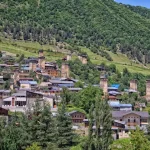
The towers — there are dozens of them rising above the rooflines of family homes — are not decorative. They were built between the 9th and 13th centuries as refuges during blood feuds and raids. Families could seal themselves inside for weeks. Some are still owned by the same families whose ancestors built them.
The Svan Towers: Reading the Stone Before You Climb
Not all towers in Mestia are open to visitors, and the ones that are vary significantly in condition. The Chaji Tower complex near the museum is the most accessible and has been stabilised with EU-funded restoration work completed in 2023. You can climb to the third level, which gives you a direct view across the rooftops toward the Ushba massif — a double-peaked summit that dominates the southern skyline on clear days.
The Lagami ethnographic complex, a 10-minute walk east of the centre, gives you a more complete picture because the tower is attached to a traditional Svan house (machubi) that has been preserved with its original interior layout. The hearth room, the sleeping platform above the cattle stall, the smoke-blackened rafters — it makes the towers make sense as part of a living system rather than isolated monuments.

A few things to know before you visit any tower:
- Entrance to museum-administered towers is 15 GEL in 2026. The combined museum and tower ticket is 25 GEL and is worth it.
- Some towers still on private land have informal entry arrangements — ask at your guesthouse. Expect to pay 10–20 GEL and to be accompanied by a family member.
- Interior staircases are steep and the wood is old. Solid footwear is not optional.
- Photography inside is generally permitted, but always ask first at family-owned sites.
Trails from Mestia: Hike Ratings, Distances, and What to Expect in 2026
The trail network around Mestia expanded meaningfully in 2024–2025 with the completion of the Svaneti Trail waymarking project, funded jointly by the Georgian National Tourism Administration and the EU Rural Development Programme. Trails are now marked with red-and-white blazes on wooden posts, and distances are posted at major junctions. This has made independent hiking significantly more reliable than it was three years ago.
The most popular routes from Mestia town:
- Mestia to Koruldi Lakes: 12 km return, 900 m elevation gain. This is the benchmark hike — hard enough to feel earned, rewarding enough to justify the effort. The lakes sit at around 2,700 m and the view back down onto Mestia with the towers visible against the valley floor is the photograph most people come for. Allow 6–7 hours. The crunch of loose shale underfoot on the final approach to the upper lake is something you feel in your knees on the way back down.
- Mestia to Zhabeshi (Hatsvali section): 8 km one way, moderate. This is the first leg of the multi-day Mestia–Ushguli trek and works well as a day hike if you arrange a vehicle return from Zhabeshi.
- Hatsvali Ski Area loop: 6 km, easy to moderate. The chairlift operates in summer (10 GEL per ride in 2026) and can cut 400 m of ascent if you want a gentler introduction to the altitude before attempting Koruldi.
Weather changes fast above 2,000 m in Svaneti. Afternoon thunderstorms are common June through August. Start any serious hike before 8:00.

Where to Eat in Mestia: Svan Food Is Not What You Think
Svan cuisine shares DNA with broader Georgian cooking but has its own distinct character shaped by altitude, long winters, and limited growing seasons. The defining flavour is svanuri marili — Svan salt — a blend of dried garlic, chili, coriander seed, fenugreek, and other spices that goes into almost everything. It is deeply savoury and slightly hot, and you will want to take a jar home.
Lali’s Guesthouse Restaurant on the road toward Hatsvali is the best place in Mestia to eat kubdari — the Svan meat pie filled with pork, onion, and svanuri marili, baked in a wood oven. The dough is thicker than a khachapuri, the filling is dense and spiced, and eating one fresh from the oven, with the crust still crackling and the fat from the pork soaking through the base, is the kind of thing that resets your expectations of what flatbread can be.
Cafe Laila on the central square does good chvishtari (cornbread with sulguni cheese) and serves draught Natakhtari beer. It is also one of the few spots with reliable Wi-Fi and fills up with hikers by 18:00.
Guesthouse Mamuka offers set dinners (50–70 GEL per person including wine or chacha) that give you a more complete Svan meal — chvishtari, tatara (a walnut-and-beer sauce served over boiled pork), smoked meats from the rafters. These need to be arranged in advance.
Getting to Mestia in 2026: Flights, Marshrutkas, and the Road Reality
Mestia is 430 km from Tbilisi by road — which, given Georgian mountain driving conditions, means 7–9 hours depending on stops and the season. The options in 2026:
- Vanilla Sky Airlines (formerly Vanilla Sky): Operates scheduled flights from Tbilisi’s Natakhtari Airport to Mestia (Mestia Airport, ICAO: UGMS) on a Tuesday–Thursday–Saturday schedule as of the 2026 summer season. The flight takes 55 minutes and costs 180–280 GEL one way depending on booking lead time. The aircraft is a 9-seat Cessna Caravan — weight limits apply to luggage (10 kg total). Seats sell out 2–3 weeks ahead in July and August.
- Marshrutka from Tbilisi (Didube terminal): Departs daily at 07:00. Cost is 40–50 GEL. The road from Zugdidi to Mestia (the final 130 km) is paved but narrow and winding. The marshrutka arrives roughly 15:00–16:00.
- Marshrutka from Zugdidi: Zugdidi is served by frequent trains from Tbilisi (from 32 GEL, roughly 5.5 hours on the updated 2025 Georgian Railway schedule). From Zugdidi, shared taxis and marshrutkas run to Mestia throughout the morning for 30–40 GEL. This two-leg approach gives you more flexibility.
- Private car from Tbilisi: Budget 350–450 GEL each way through reputable drivers. Worth it for groups of three or four, especially with hiking gear.

How Long You Actually Need in Mestia
The minimum meaningful stay is two nights, which allows one full day for a major hike (Koruldi or the Zhabeshi direction) and one half-day for the museum, towers, and town. Three nights is better and lets you either attempt the first leg toward Ushguli or take a vehicle excursion to the Chalaadi Glacier (16 km from Mestia, accessible by 4×4 or on foot in about 2.5 hours each way).
If you have five days or more, the Mestia–Ushguli trek (four days, approximately 45 km) is the reason many serious hikers come to Svaneti at all. Ushguli, at 2,200 m, is one of the highest permanently inhabited settlements in Europe and has its own tower cluster and an entirely different feel from Mestia.
2026 Budget Reality: What Mestia Costs Now
Mestia is more expensive than most Georgian regional towns because of its remoteness — almost everything is transported in by road. Prices rose approximately 15% between 2024 and 2026 alongside increased tourism demand.
- Budget: Dorm bed in a guesthouse: 40–60 GEL per night. Self-catered meals from the small supermarkets near the square: 20–30 GEL per day. Total daily spend around 80–100 GEL.
- Mid-range: Private room in a guesthouse with breakfast: 120–180 GEL per night. Eating at local restaurants for two meals: 50–70 GEL per day. Total daily spend around 180–250 GEL.
- Comfortable: Rooms at Mestia’s two upgraded hotels (Hotel Tetnuldi and Guesthouse Old House have both added en-suite options since 2024): 220–320 GEL per night. Guided day hike with a local guide: 120–180 GEL. Total daily spend 350–500 GEL.
Chacha (local brandy) at a guesthouse dinner costs 5–8 GEL per glass. Local honey, which is outstanding in Svaneti, sells for 20–35 GEL per jar at the weekend market.
Practical Tips Before You Go
- Best season: June to September for hiking. July and August are the warmest but also the busiest and most prone to afternoon storms. Late June and early September offer better weather windows and fewer crowds.
- Altitude: Mestia itself is manageable at 1,500 m for most people, but take it easy on the first day before attempting any serious ascent. The Koruldi trail goes above 2,700 m — headaches are common for visitors coming directly from sea level.
- Mobile coverage: Magticom and Geocell both have 4G coverage in Mestia town and along the main valley trails. Coverage disappears above 2,400 m on most routes. Download offline maps (Maps.me has the Svaneti trail network updated to 2025) before you head out.
- ATMs: There is one functioning ATM in Mestia (Bank of Georgia branch near the museum). It runs out of cash on busy summer weekends. Carry GEL from Tbilisi or Zugdidi.
- Winter travel: Mestia receives heavy snow from November through April. The road from Zugdidi is kept open but can close for 24–48 hours after major snowfalls. The Hatsvali ski area operates from approximately December to March. If skiing, book accommodation at least three weeks ahead.

Frequently Asked Questions
Is Mestia safe for solo travellers?
Yes. Mestia has a low crime rate and solo hikers — including solo women — travel the main trails regularly. The main risks are weather-related and altitude-related rather than personal safety. Tell your guesthouse host your planned route before any hike above 2,000 m, as a basic precaution.
Do I need a guide to hike around Mestia?
For the Koruldi Lakes and Zhabeshi day hikes, the 2025 trail waymarking means independent hiking is fully viable with a downloaded offline map. A guide becomes more useful for the Mestia–Ushguli multi-day route, off-trail routes, or if you are inexperienced in mountain environments. Local guides charge 120–180 GEL per day.
What is the best way to get from Tbilisi to Mestia?
For comfort and speed, the Vanilla Sky flight from Natakhtari Airport (55 minutes, 180–280 GEL) is the best option if seats are available. For budget travellers, the daily marshrutka from Didube terminal (40–50 GEL, around 8–9 hours) is the standard route. The train to Zugdidi plus a shared taxi is a flexible middle ground.
Can I visit Mestia in winter?
Yes — Mestia has a functioning ski area at Hatsvali with two chairlifts and groomed runs. The skiing is modest compared to European resorts but the scenery is exceptional. The town has far fewer tourists in winter, guesthouse prices drop, and some restaurants close, so check ahead. Road conditions can cause delays after heavy snowfall.
How far is Ushguli from Mestia, and can I visit in a day?
Ushguli is approximately 45 km from Mestia by road and around 2.5–3 hours by 4×4 vehicle (road is unpaved and rough from Mestia onward). A day excursion by hired vehicle is possible from Mestia and costs roughly 200–280 GEL for the vehicle. Most serious visitors spend at least one night in Ushguli to experience it properly.
📷 Featured image by Ksenia Lauróva on Unsplash.