On this page
- What Gori Actually Is
- The Stalin Museum: What to Expect Honestly
- Gori Fortress: The View Nobody Talks About
- The Food Scene in Gori: Where Locals Actually Eat
- Day Trip or Overnight? Making the Call
- Getting to Gori from Tbilisi and Kutaisi
- 2026 Budget Reality: What Gori Costs
- Practical Tips Before You Go
- Frequently Asked Questions
💰 Click here to see Georgia Budget Breakdown
💰 Prices updated: October, 2026. Budget figures are estimates — always verify before travel.
Exchange Rate: $1 USD = ₾2.60
Daily Budget (per person)
Shoestring: ₾70.00 – ₾130.00 ($26.92 – $50.00)
Mid-range: ₾180.00 – ₾350.00 ($69.23 – $134.62)
Comfortable: ₾500.00 – ₾1,000.00 ($192.31 – $384.62)
Accommodation (per night)
Hostel/guesthouse: ₾30.00 – ₾60.00 ($11.54 – $23.08)
Mid-range hotel: ₾110.00 – ₾200.00 ($42.31 – $76.92)
Food (per meal)
Budget meal: ₾15.00 ($5.77)
Mid-range meal: ₾35.00 ($13.46)
Upscale meal: ₾100.00 ($38.46)
Transport
Single metro/bus trip: ₾1.00 ($0.38)
Monthly transport pass: ₾40.00 ($15.38)
Gori divides visitors more than almost any other town in Georgia. Some leave underwhelmed after a rushed three-hour day trip; others stay the night and quietly admit it was one of the more memorable stops of their trip. In 2026, the town is seeing a modest uptick in independent travellers who are deliberately skipping the Stalin Museum entirely and finding Gori surprisingly rewarding on its own terms. This guide is for both camps — the Stalin-curious and the history-allergic — because Gori genuinely has something to offer each.
What Gori Actually Is
Gori sits about 80 kilometres west of Tbilisi in the Shida Kartli region, straddling the Liakhvi and Mtkvari rivers. It is a mid-sized Georgian regional town of roughly 45,000 people, and it functions like one: a working market on the main square, marshrutkas idling at the station, elderly men playing backgammon in the shade of Soviet-era apartment blocks. It is not a tourist town dressed up to receive you.
The 2008 Russia-Georgia war left visible marks here — not in rubble, but in collective memory. The town was briefly occupied, and some of that tension has reshaped local identity in ways you will sense in conversation if you spend a night. Since 2024, Georgia’s geopolitical situation has remained complex, and Gori’s proximity to the South Ossetia administrative boundary line (about 20 kilometres north) means the town carries a weight that Tbilisi day-trippers rarely appreciate. That context makes Gori more interesting, not less.
The Stalin Museum: What to Expect Honestly
You will probably visit. Almost everyone does. The Stalin Museum on Stalin Avenue is one of the strangest curatorial experiences in the former Soviet Union — not because of what it shows, but because of what it refuses to say. The exhibition presents Stalin’s life in a largely celebratory tone, with comparatively little space given to the Great Terror, the Gulag system, or the deportations of entire ethnic groups. In 2026, the museum has added a small supplementary room with more critical context following years of pressure from Georgian civil society groups, but the overall framing remains uncomfortable in a way worth thinking about before you arrive.
What the museum does well: the personal objects. Stalin’s actual death mask, his personal railway carriage parked outside (you can step inside it), the cramped two-room stone cottage where he was born, still preserved under its ornate Soviet canopy. The scale of the building — a neoclassical palace built to glorify a living dictator — is itself a historical document worth reading.
Entrance in 2026 costs 20 GEL for adults, with guided tours available in English for an additional 30 GEL. Allocate 90 minutes minimum if you want to do it properly. The railway carriage alone deserves twenty minutes.
Gori Fortress: The View Nobody Talks About
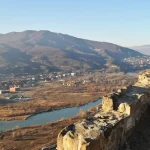
Walk ten minutes from the museum and you hit the base of Goris Tsikhe, the fortress that crowns the rocky hill at the centre of town. Most day-trippers glance at it from the road and move on. That is a mistake. The climb takes about fifteen minutes on a zig-zagging stone path, and what greets you at the top is a panorama that genuinely earns the effort: the flat Kartli plain stretching south toward the Trialeti mountains, the Mtkvari river bending below, and on a clear day, the snow-capped Greater Caucasus range to the north. In early morning, when the light is low and amber, the scene has a stillness that the crowded museum courtyard below never offers.
The fortress itself is mostly ruined — medieval foundations with some later additions — and there are no entrance fees, no facilities, and no crowds. The path is uneven in places, so proper footwear matters. Children and anyone with mobility difficulties should note the steeper upper section. Sunrise visits are completely feasible if you stay overnight in Gori.
The Food Scene in Gori: Where Locals Actually Eat
Gori does not have a restaurant scene designed for tourists, which is exactly why eating here can be one of the better regional food experiences in Shida Kartli. The town’s bakers start early, and the smell of fresh bread drifting from the side-street tone (traditional Georgian ovens) around 7am is the sensory alarm clock nobody asked for but everyone appreciates. Tear into a fresh shotis puri — long, canoe-shaped Georgian bread — while it is still hot enough to burn your fingers, and you will understand why Georgians consider bread a near-sacred thing.
For proper meals, the covered market near the central square has a row of small khinkali vendors where dumplings are handmade and cost around 1.50–2 GEL each. Arrive between noon and 2pm for the best selection. Restoran Gori on Chavchavadze Street is reliably good for mtsvadi (Georgian shashlik) and lobiani (bean-filled bread), with outdoor seating that fills with locals in the evening. Café Moambe, near the museum, caters more visibly to tourists but maintains honest quality — the chakapuli (lamb stewed with tarragon) in spring is particularly good.
Avoid the overpriced cafés immediately adjacent to the museum entrance. Prices double, portions shrink, and the food is indifferent.
Day Trip or Overnight? Making the Call
Most visitors treat Gori as a day trip from Tbilisi, and for the Stalin Museum alone, that is sufficient. The train or marshrutka gets you there in under two hours, the museum takes 90 minutes to two hours, the fortress another hour, lunch at the market — you are back in Tbilisi by early evening with a full day accounted for.
But staying overnight opens up two things a day trip cannot offer. First, the fortress at sunrise, before the heat and the tour buses. Second, the option to use Gori as a base for the cave city of Uplistsikhe, which is only 12 kilometres east of town. Uplistsikhe is one of the oldest urban settlements in the Caucasus, a fascinating rock-hewn city dating back to the early Iron Age, and it deserves a proper morning rather than the exhausted final hour of a long day trip. From Gori, a taxi to Uplistsikhe costs around 30–40 GEL return, and the driver will usually wait.
If you are travelling with children, have a particular interest in Soviet history, or want to combine Gori with Uplistsikhe in unhurried fashion, one night here pays dividends. Otherwise, a well-planned day trip covers the essentials.
Getting to Gori from Tbilisi and Kutaisi
From Tbilisi, marshrutkas to Gori depart from Didube bus terminal throughout the day, with departures roughly every 30–45 minutes from early morning. Journey time is 1.5 to 2 hours depending on traffic; the fare is around 6–7 GEL. Marshrutkas drop you near the Gori bus station, from which the Stalin Museum is a 10-minute walk.
Georgian Railway runs several trains daily on the Tbilisi–Gori–Kutaisi–Batumi corridor. In 2026, following schedule updates introduced in late 2025, there are four direct trains from Tbilisi Central to Gori, with journey times of approximately 1 hour 20 minutes. A standard seat costs 5–8 GEL. Trains are punctual and comfortable — the better option if you dislike marshrutka driving styles.
From Kutaisi, marshrutkas run to Gori with a change typically required in Khashuri. Allow 2.5 to 3 hours. This route is less common for tourists but straightforward.

2026 Budget Reality: What Gori Costs
- Budget: 80–120 GEL per person per day. This covers a bed in a simple guesthouse (40–55 GEL), market khinkali lunches, bread and cheese from the bakery for breakfast, dinner at a local canteen, and museum entry without a guided tour.
- Mid-range: 150–220 GEL per person per day. Add a private room in a decent guesthouse or small hotel (80–100 GEL), the English guided tour at the museum, a sit-down dinner at Restoran Gori, and a return taxi to Uplistsikhe.
- Comfortable: 250–320 GEL per person per day. This is the upper ceiling in Gori — the town does not have luxury hotels. You are paying for more flexibility: private transport from Tbilisi (around 120–150 GEL one way by taxi or hired car), meals with wine, and unhurried scheduling.
Gori remains one of the most affordable overnight destinations within two hours of the capital. Prices have risen roughly 15% since 2023 in line with broader Georgian inflation, but the town is still genuinely good value by any European comparison.
Practical Tips Before You Go
- The Stalin Museum is closed on Mondays. Do not arrive on a Monday expecting to get in.
- There is no ATM inside the museum complex. Withdraw cash in Tbilisi or use the Bank of Georgia ATM on Stalin Avenue before heading to the fortress.
- Gori gets hot in July and August — temperatures regularly reach 36–38°C. Visit the fortress early in the day. Carry water; there are no facilities at the top.
- The town has limited English signage outside the museum. Basic Georgian phrases or a translation app earn significant goodwill.
- Mobile coverage in Gori is good. Magti and Silknet both provide reliable 4G. The route to Uplistsikhe also has coverage throughout.
- If you are driving from Tbilisi on the S1 highway, note that the route passes through areas near the South Ossetia administrative boundary. Stay on marked roads; do not approach the boundary line. Georgian authorities have clear signage in the relevant zones.
Frequently Asked Questions
How long do you need in Gori?
A well-organised day trip from Tbilisi covers the Stalin Museum, Gori Fortress, and lunch at the market in six to seven hours. If you want to add Uplistsikhe cave city or see the fortress at sunrise, one overnight stay is the practical minimum. There is little reason to stay longer than two nights.
Can you skip the Stalin Museum and still enjoy Gori?
Absolutely. The fortress has excellent views, the market is lively and authentic, and using Gori as a base for Uplistsikhe is independently worthwhile. Some visitors with no interest in Soviet history find they enjoy Gori more precisely because they skip the museum and explore the town at a slower pace instead.
What is the best time of year to visit Gori?
April to June and September to October offer the most comfortable conditions — warm enough for the fortress climb, not brutally hot, and with good light for the Kartli plain views. Winter visits are quiet and cold, with temperatures dropping below 0°C overnight, but the museum is open year-round except Mondays.
Is Uplistsikhe easy to visit from Gori?
Yes. Uplistsikhe is 12 kilometres east of Gori, reachable by taxi for 30–40 GEL return with waiting time. There is no reliable public transport directly to the site, so a taxi or a hired car is the standard approach. The site itself requires comfortable walking shoes and takes around two hours to explore properly.