On this page
- The Language Barrier Is Real — But Not Insurmountable
- Essential Phrases That Actually Get You Through the Day
- The Alphabet on the Street
- How Georgians Communicate Without Words
- The Hospitality Code — What “Guest Is From God” Really Means in Practice
- The Supra Table: Unwritten Rules You Need to Know Before You Sit Down
- Church, Faith, and Everyday Orthodox Life
- 2026 Budget Reality: What Culture Costs
- Frequently Asked Questions
Georgia in 2026 is receiving more first-time visitors than ever, partly because of new direct flight routes from Europe and the Gulf into both Tbilisi and Kutaisi, and partly because the country keeps appearing on “undiscovered” lists despite being anything but. The problem is that most of those arrivals land with almost zero cultural preparation. They expect something vaguely Eastern European and find something that defies every category they know. This article exists to close that gap — not with vague advice to “be respectful,” but with specific, usable knowledge that will make your first days in Georgia feel natural rather than awkward.
The Language Barrier Is Real — But Not Insurmountable
Georgian is not related to Russian, Arabic, Turkish, or any Indo-European language. It belongs to the Kartvelian language family — a completely isolated group with no confirmed relatives outside the South Caucasus. That means your Spanish, your French, your Hindi, your Farsi — none of it gives you even a partial foothold. You are starting from zero.
The script is called Mkhedruli, and it looks like nothing you have seen before. It is a flowing, rounded alphabet of 33 letters, written left to right. Each letter has exactly one sound — no silent letters, no ambiguous combinations. That is actually good news: once you learn the phonetic values, the language is consistent. The bad news is that learning those values takes real effort.
Georgian also stacks consonants in ways that feel physically impossible. The word for “train station” is sadguri. The word for “airport” is aeroporti (borrowed, mercifully). But common words like mtskheta (a major historical city) or gvprkvevs (a verb form meaning “he makes us understand”) will make you feel like your mouth is malfunctioning. Do not let this discourage you. Georgians are extraordinarily patient with foreign attempts at their language, and a single correct “gamarjoba” will get you more goodwill than a week of polite nodding.
In Tbilisi and Batumi, English is increasingly functional — especially among people under 40. In rural areas, Kakheti villages, mountain communities in Svaneti or Tusheti, Russian is still more commonly understood than English among older residents. Georgian is always the safest bridge.
Essential Phrases That Actually Get You Through the Day
You do not need fluency. You need maybe fifteen words used with confidence. Here are the ones that matter most, with pronunciation written so that non-linguists can actually use them.
- Gamarjoba (gah-mar-JO-bah) — Hello. Use this constantly. Morning, afternoon, entering a shop, meeting someone’s grandmother at a guesthouse. It never gets old and it always lands well.
- Gmadlobt (gmad-LOBT) — Thank you. The “gm” cluster at the start is real. Say the G and M almost simultaneously, then flow into “adlobt.” Georgians will appreciate the effort even if it comes out rough.
- Ki (key) — Yes.
- Ara (AH-rah) — No.
- Bodishi (bo-DEE-shee) — Sorry / Excuse me. Useful in crowded markets and when you inevitably step into someone’s way on Rustaveli Avenue.
- Ra ghirs? (rah GHEERZ) — How much does it cost? The “gh” is a soft gargling sound, like a French R.
- Saidan xar? (sah-ee-DAN khar) — Where are you from? Georgians ask this within thirty seconds of meeting you. Know how to answer: “Inglisidan var” (I am from England), “Amerikidan var” (I am from America), and so on, replacing the country name.
- Ar mesmis (ar MES-mees) — I don’t understand. Paired with a shrug, this opens the door to simpler communication.
- Nela, nela (NEH-lah, NEH-lah) — Slowly, slowly. Say this when someone is speaking too fast and you need them to repeat themselves at human speed.
- Gaumarjos! (gah-oo-MAR-jos) — Cheers! If you sit at any Georgian table, you will need this. Say it with eye contact and a genuine smile.
The Alphabet on the Street
Even if you never speak a word of Georgian, learning to recognise a handful of Mkhedruli letters will make daily navigation dramatically easier. Street signs in Tbilisi and most larger towns appear in both Georgian and Latin script since 2022 standardisation efforts — but rural buses, regional minibuses (marshrutkas), and many market stalls are Georgian-only.
Start with the letters that correspond to sounds in the words you already know. The letter that looks like a backwards “3” with a tail makes the sound “s.” The tall looping letter that resembles a treble clef makes “t.” The circular letter with an opening at the top makes “o.” You are not trying to read fluently — you are trying to recognise key words like სადგური (sadguri, station), სასტუმრო (sastumro, hotel), კაფე (kape, café), and ტუალეტი (tualeti, toilet).
On restaurant menus, photographs are your best friend. When there are none, point and ask “es ra aris?” — “what is this?” It works, and it often turns into a five-minute conversation about the dish, the region it comes from, and whether your host’s version is better than everyone else’s. It usually is, according to them.

How Georgians Communicate Without Words
A flat upward tilt of the chin means “no” — not nodding agreement or an invitation to speak. This trips up nearly every first-time visitor. If you ask “is the marshrutka going to Mtskheta?” and the driver tilts his chin up sharply once, he is saying no, not gesturing for you to get on.
A slow side-to-side head shake can mean “yes, absolutely” or “what a thing, how wonderful” — a kind of amazed affirmation. Context matters. Watch the eyes. If someone is smiling warmly and shaking their head while listening to your story, they are expressing delight, not contradiction.
Physical space norms are closer than in Northern Europe or North America. Georgians, especially older men, may stand very close during conversation. This is not aggression or flirtation — it is normal conversational proximity. Stepping back will be interpreted as coldness rather than comfort.
Eye contact during toasts and conversations is important. Looking away while someone is speaking to you reads as disinterest or disrespect. Hold the gaze comfortably. It signals you are engaged and present.
The Hospitality Code — What “Guest Is From God” Really Means in Practice
The Georgian phrase stumari ghvtisagan aris — “the guest is from God” — is not a charming saying. It is a social contract. If a Georgian invites you into their home, they are taking on a genuine obligation to feed you, protect you, and make you feel that their house exists for your comfort. Refusing food is not simply declining a snack — it is rejecting a form of care that your host has structured their afternoon around.
This has practical implications. When you visit a guesthouse in Kazbegi or a family home in a Kakhetian village, you will be fed whether you are hungry or not. The table will be set with more dishes than physically makes sense for the number of people present. You are expected to try everything. Saying “me diet var” (I am on a diet) will be treated as a polite fiction at best and a personal affront at worst. Eat what you can. Express genuine pleasure. The warmth in the room when you do this is something no travel app can simulate — it feels like stepping into a heat you did not know you were missing.

The Supra Table: Unwritten Rules You Need to Know Before You Sit Down
A supra is a formal Georgian feast, and it has a structure as organised as a church service. The tamada — the toastmaster — is elected or assumed at the start. This person controls the flow of the meal through toasts. You do not drink until the tamada raises the glass. You do not give your own toast until you have been invited to do so, or until the meal is relaxed enough that it has become informal. Starting a toast uninvited at a formal supra is the equivalent of walking to the front of a wedding ceremony and delivering your own speech.
Toasts follow a sequence: to Georgia, to peace, to family, to guests, to the dead, to children, to love. The tamada speaks; everyone listens; then everyone drinks together. When it is your turn — and it will be your turn — keep it sincere and short. A genuine sentence about gratitude for being welcomed will go over better than a long, clever toast that nobody can follow.
Chacha — Georgian grape spirit, typically 50–60% alcohol — will appear. It is poured freely and repeatedly. There is no shame in covering your glass with your hand. Georgians respect a clear “ara, gmadlobt” (no, thank you) far more than a reluctant yes followed by visible suffering.
Church, Faith, and Everyday Orthodox Life
Georgia is one of the oldest Christian nations on earth — Christianity became the state religion in 337 CE. The Georgian Orthodox Church is not a background institution. It is a living, daily presence in the way people greet each other, mark time, celebrate births, mourn deaths, and understand their national identity.
When entering any Orthodox church — Svetitskhoveli in Mtskheta, Sameba Cathedral in Tbilisi, a tiny village church in the Alazani valley — the rules are firm. Women must cover their heads. Both men and women must cover bare shoulders and knees. Fabric wraps are available at the entrance of most major churches; at smaller ones, carry a scarf. Photography inside is sometimes permitted and sometimes not — watch what others are doing, or ask quietly. Flash photography near icons is universally unwelcome.
Candles are a central act of devotion. You will see Georgians buying thin wax tapers at the entrance and lighting them before specific icons. If you want to participate respectfully, this is acceptable — it is not considered appropriation but rather a genuine gesture of participation. Place a small offering (a few lari) in the tray.

Do not walk in front of someone who is praying, and do not speak loudly. The atmosphere inside Georgian churches is one of deep, personal quiet — the kind that feels thick with something older than the building itself.
2026 Budget Reality: What Culture Costs
Georgia remains significantly more affordable than Western Europe, though prices in Tbilisi have risen noticeably since 2023 due to increased visitor numbers and post-pandemic adjustments.
- Church and monastery entrance: Most are free. A voluntary donation of 2–5 GEL is appropriate at smaller sites. Larger sites like Davit Gareja may charge 5–10 GEL.
- Museum entrance (budget): 5–8 GEL for regional and city museums.
- Museum entrance (mid-range): 15–25 GEL for national institutions like the Georgian National Museum in Tbilisi.
- Licensed cultural guide (half day): 80–150 GEL depending on the route and language.
- Supra experience (organised, includes wine and chacha): 60–120 GEL per person in 2026.
- Language phrasebook or app (offline): 0–15 GEL.
- Tipping norm: 10% is standard in restaurants. In a private home or guesthouse, a small gift (chocolate, wine, something from your country) is more meaningful than cash.
One important 2026 update: several heritage sites now require advance online booking, including Davit Gareja and certain areas within the Vardzia cave monastery complex. Walk-up access is still possible but timed entry slots fill quickly in summer. Check the Georgian National Tourism Administration portal before you travel.
Frequently Asked Questions
Do I need to speak Georgian to get around Georgia as a tourist?
Not fluently, but a handful of basic phrases — gamarjoba, gmadlobt, ki, ara — will open doors that polite silence cannot. In Tbilisi and Batumi, English works well with younger residents. In rural areas, Russian is more common among older locals. Georgian is always welcomed, however imperfect your attempt.
Is it rude to refuse food or drink at a Georgian table?
It can feel that way to your host, especially in a home setting. The safest approach is to accept a small amount of everything, eat what you can, and express genuine appreciation. For alcohol, a firm but warm “ara, gmadlobt” (no, thank you) with a hand over your glass is respected. Do not fake drinking — Georgians will notice.

What should women wear when visiting Georgian Orthodox churches?
A head covering is required — a scarf or shawl works perfectly. Shoulders and knees must also be covered for both men and women. Fabric wraps are usually available at major church entrances. At smaller village churches, bring your own. Dressing modestly is not a request — it is the condition of entry.
How does the tamada system work at a supra, and what is expected of guests?
The tamada is the toastmaster who leads the meal through a sequence of formal toasts. Guests drink when the tamada drinks, and give their own toast only when invited or when the meal becomes informal. Keep your toast sincere and short — a few sentences of genuine gratitude will land better than anything clever or elaborate.
Is Georgian script really impossible to learn as a traveller?
Not impossible — just unusual. You do not need to master it, but recognising five to ten key words in Mkhedruli (station, hotel, toilet, café, market) will make navigation significantly easier, especially on rural marshrutkas and local market stalls where Latin-script signage is absent. The alphabet is phonetically consistent, which helps.
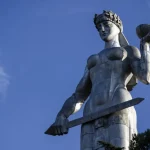
📷 Featured image by Elena Mozhvilo on Unsplash.