On this page
- Two Monasteries, One Road, and Why Most Visitors Get It Wrong
- Gelati Monastery: Reading the Walls Before You Walk Through the Gate
- Motsameta Monastery: The One That Rewards Patience
- Getting There from Kutaisi in 2026
- What It Costs to Visit: 2026 Budget Reality
- Sequencing Your Day: How to Make This More Than a Rushed Half-Morning
- Where to Eat When You’re Back on the Road
- Photography, Dress Codes, and What to Know Before You Walk Through the Gate
- Frequently Asked Questions
💰 Click here to see Georgia Budget Breakdown
💰 Prices updated: October, 2026. Budget figures are estimates — always verify before travel.
Exchange Rate: $1 USD = ₾2.60
Daily Budget (per person)
Shoestring: ₾70.00 – ₾130.00 ($26.92 – $50.00)
Mid-range: ₾180.00 – ₾350.00 ($69.23 – $134.62)
Comfortable: ₾500.00 – ₾1,000.00 ($192.31 – $384.62)
Accommodation (per night)
Hostel/guesthouse: ₾30.00 – ₾60.00 ($11.54 – $23.08)
Mid-range hotel: ₾110.00 – ₾200.00 ($42.31 – $76.92)
Food (per meal)
Budget meal: ₾15.00 ($5.77)
Mid-range meal: ₾35.00 ($13.46)
Upscale meal: ₾100.00 ($38.46)
Transport
Single metro/bus trip: ₾1.00 ($0.38)
Monthly transport pass: ₾40.00 ($15.38)
Two Monasteries, One Road, and Why Most Visitors Get It Wrong
In 2026, Kutaisi has become one of Georgia’s most-visited cities, partly because Wizz Air and FlyOne expanded their direct routes into Kutaisi International Airport, putting the Imereti region on the radar of travelers who once flew straight to Tbilisi. That’s good news for the city. It’s created a problem for Gelati and Motsameta. Both monasteries sit within 10 kilometres of Kutaisi’s centre, and both now absorb large midday crowds between 11:00 and 14:00. The common mistake is treating them as a quick tick-box — 45 minutes at Gelati, a photo at Motsameta, and back to the city for lunch. That approach leaves you with bad lighting, a crowded nave, and the distinct feeling that you missed something. This guide is for the traveler who wants to actually understand these places, not just visit them.
Gelati Monastery: Reading the Walls Before You Walk Through the Gate
Gelati is a UNESCO World Heritage Site, but that designation undersells what you’re standing in front of. Founded in 1106 by King David the Builder, the monastery complex sits in a wooded valley about 11 kilometres northeast of Kutaisi. The air up there carries pine resin and damp moss, especially in the mornings, and the stone walls have a greenish tinge from centuries of Imereti humidity. This is not a pristine, restored museum piece — it is a working monastery, and that roughness is part of what makes it worth the trip.
The main Cathedral of the Virgin, the largest building in the complex, is where most visitors spend their time. The 12th-century mosaic of the Virgin and Child in the apse is one of the finest surviving examples of Byzantine-Georgian art anywhere in the Caucasus. The gold tessera catches even flat morning light and throws it back in a way that photographs simply cannot replicate. Stand in the nave for five minutes without your phone and the scale of the thing lands differently. The ceiling is high, the walls are thick, and the frescoes — many damaged, some repainted in later centuries — cover nearly every surface.
What many visitors walk past: the tomb of David the Builder is set into the gate itself, in the south entrance. The king reportedly requested this spot so that every person entering the monastery would walk over him. That’s not a legend — it’s documented, and the flat stone slab is still there underfoot. Walk through the gate slowly.
The Academy of Gelati, which once operated beside the monastery as one of the great intellectual centres of medieval Georgia, no longer stands in its original form. But the Church of St. George and the Church of St. Nicholas remain within the walled complex. The Church of St. Nicholas contains frescoes that are in significantly better condition than those in the main cathedral, and most visitors spend almost no time there. That’s a mistake.
Motsameta Monastery: The One That Rewards Patience
Motsameta sits about 6 kilometres from Kutaisi on a narrow forested promontory above the Tskhaltsitela River gorge. Most people know it as a quick stop after Gelati — 15 minutes, a look at the church, back in the car. That approach means you’ve seen nothing. The drive in along the gorge road is itself worth the detour: the river runs green and fast below a series of limestone cliffs, and in early spring the surrounding forest is loud with birds.
The monastery’s full name translates roughly to “place of martyrs,” and the church was built in the 11th century to hold the remains of two brothers, Argveti princes David and Constantine, who were executed by an Arab commander in the 8th century after refusing to convert. Their relics are kept in a stone sarcophagus inside the small church, and Georgians come here as pilgrims, not just tourists. You’ll see people lighting candles, sitting in prayer, and occasionally walking around the sarcophagus three times — a traditional ritual believed to bring good fortune.
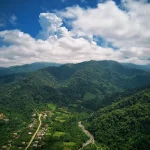
The physical setting is extraordinary in a way that’s easy to miss if you’re rushing. The monastery perches at the very end of the promontory, with a sheer drop into the gorge on three sides. Step carefully to the edges and look down: the Tskhaltsitela River is 40 or 50 metres below, the limestone walls are vertical, and the forest crowds in from both banks. In autumn, when the leaves turn, this view is one of the more quietly dramatic things you can see in all of western Georgia.
The church itself is small — genuinely small, perhaps 15 people at capacity — and the interior is dark even in daylight. A single window lets in a bar of light that shifts across the stone floor during the day. The carvings around the entrance portal are worn smooth but worth examining: the ornamental detail in the stonework reflects an earlier, simpler Georgian church-building tradition than Gelati’s more elaborate Byzantine-influenced forms.
Getting There from Kutaisi in 2026
The good news: the road connecting Kutaisi to both monasteries has been resurfaced and is in decent condition as of 2026. The less good news: there is no reliable public bus service that covers both sites in a single trip.
Taxi
A private taxi from Kutaisi that covers both Gelati and Motsameta — waiting while you visit each — costs between 60 and 90 GEL for the full round trip depending on how long you spend at each site and how well you negotiate before getting in. Bolt operates in Kutaisi in 2026, and you can sometimes find rides through the app, but for a waiting-and-return arrangement you’re better off agreeing terms with a driver directly outside Kutaisi’s central market or your accommodation. Most guesthouse owners can arrange this by the night before for a fair price.
Marshrutka (Shared Minibus)
Marshrutkas to Gelati run from Kutaisi’s central bus station on Tskaltubo Street and cost around 1 GEL per seat. They run irregularly — roughly every hour during peak season, less often in winter. They will drop you at the Gelati access road, from which it’s a 10-minute uphill walk to the monastery gate. Marshrutkas do not serve Motsameta directly. You would need to either take a separate taxi from Gelati to Motsameta (around 20–25 GEL) or combine with a Kutaisi-based taxi for the full loop.
Rental Car or Scooter
Several rental agencies operate near Kutaisi airport in 2026. Having your own vehicle is genuinely the best option for this combination. The drive from Kutaisi to Gelati takes about 20 minutes, and from Gelati to Motsameta is another 15 minutes on the gorge road. You can sequence them however suits your day.
Organised Day Tours
Multiple Kutaisi guesthouses and the city’s tourism office on King David Street offer half-day tours combining Gelati, Motsameta, and sometimes the Prometheus Cave or Sataplia Nature Reserve. These typically run 50–80 GEL per person for a small group. If you’re solo or as a couple, a private taxi is usually cheaper and more flexible.
What It Costs to Visit: 2026 Budget Reality
Entry to both Gelati and Motsameta monasteries is free. There are no admission tickets. Donations are accepted at both sites, and given that both are active religious communities, a small contribution (5–10 GEL) when you light a candle or leave something in the donation box is appropriate and appreciated.
- Budget tier: Marshrutka to Gelati (1 GEL each way) + separate taxi to Motsameta (20–25 GEL) = roughly 25–30 GEL total transport. Bring your own snacks and water from Kutaisi. Total day cost: 30–40 GEL.
- Mid-range tier: Round-trip private taxi covering both sites with waiting time: 60–90 GEL. Lunch at a restaurant near Kutaisi on the return: 25–40 GEL per person. Total day cost: 90–130 GEL.
- Comfortable tier: Private driver arranged through your hotel, guided by a licensed local guide (80–120 GEL for guiding services on top of transport), lunch at one of Kutaisi’s better restaurants. Total day cost: 180–250 GEL.
There are no souvenir stalls at Motsameta. Gelati has a small stand near the gate selling candles, icons, and locally produced church wine — prices are fixed and fair, typically 15–40 GEL for a bottle of wine.
Sequencing Your Day: How to Make This More Than a Rushed Half-Morning
The single best structure for a full day at both sites is to visit Motsameta first, then Gelati, and here’s why: Motsameta gets direct morning sun on its promontory approach road and the gorge is at its quietest before 10:00. More importantly, the large tour groups almost always go to Gelati first because it’s closer to Kutaisi and more famous. If you reverse the order, you’ll have Motsameta entirely to yourself for the first hour, then arrive at Gelati as the early crowds are thinning before the next wave arrives around 11:30.
Leave Kutaisi by 8:30. Spend 45 minutes to an hour at Motsameta — walk the full perimeter of the promontory, not just through the church door. Then drive to Gelati. Spend 90 minutes to two hours there, including time in all three churches and the grounds. You’ll be back in Kutaisi by early afternoon.
If you want to extend the day, the Prometheus Cave (Kumistavi Cave) is 20 kilometres further northwest and takes 90 minutes to two hours to see. It’s a different kind of experience entirely — a guided underground tour through stalactite formations — and combining it with the two monasteries makes for a genuinely full day rather than a rushed one.
One thing to plan around: both monasteries observe Orthodox religious holidays and feast days with additional services. On major feast days, the churches may be partially inaccessible to tourists during liturgy. Georgia follows the Julian calendar for most religious observances, so these dates do not align with the Gregorian calendar dates most international travelers will expect. Check with your accommodation or the Georgian tourism portal before visiting around Christmas (January 7), Easter (variable), or Mariamoba (August 28), which is the feast of the Virgin Mary — directly relevant to Gelati’s dedication.
Where to Eat When You’re Back on the Road
There are no restaurants at either monastery site. Gelati has a small parking area with an occasional vendor selling churchkhela and water in summer, but don’t rely on it. Motsameta has nothing. Plan your eating around Kutaisi.
If you’re heading back to Kutaisi for lunch, the Rioni Market area near the central bridge is where the city actually eats — the ground-floor counters inside sell fresh-baked bread, boiled eggs, lobiani, and mchadi. It’s fast, it’s cheap (a full lunch under 15 GEL), and it’s where you’ll see Kutaisi residents rather than tour groups.
The restaurant strip along Tsminda Nino Street in the Gabashvili neighbourhood has expanded since 2024 with several newer openings that do reasonably well with Imeretian cuisine at mid-range prices — expect 30–50 GEL per person with wine. For something more atmospheric, the cluster of restaurants near the Colchi Fountain on the main square caters more to tourists but has reliable kitchens.
If you’re extending your day toward Prometheus Cave, the village of Kumistavi has two or three small family restaurants on the main approach road that serve simple Georgian food at honest prices. The kind of place where lunch arrives on a shared table and includes more bread than you ordered.
Photography, Dress Codes, and What to Know Before You Walk Through the Gate
Both Gelati and Motsameta are active Orthodox monasteries. The dress code is straightforward and strictly observed: shoulders and knees must be covered for both men and women. Scarves and wraps are available to borrow at Gelati’s entrance gate — there’s usually a basket near the door. At Motsameta, there may or may not be wraps available depending on the day, so carry your own.
Photography is permitted in the grounds of both monasteries. Inside the churches, the rule varies by the day and by the officiating monks. In general, photography during active prayer or liturgy is not acceptable. Outside of service times, most visitors photograph the interior frescoes without issue, but be sensitive — if a monk or nun indicates otherwise, comply immediately without debate.

Flash photography damages the medieval frescoes. Don’t use it. The mosaic in Gelati’s main cathedral is best captured in natural light from the windows. The interior of Motsameta’s church is too dark for useful photography without a high-ISO setting — that’s simply the reality of a small medieval church with one window.
Drone use near both monasteries is prohibited without advance permission from the Patriarchate of Georgia. This rule has been increasingly enforced since 2025 following several incidents. Don’t risk it.
At Gelati, the tomb of David the Builder beneath the south gate is a site of particular reverence. Visitors sometimes stand on it or use it as a seat without realising what it is. Be aware of where you’re standing.
Both sites have outdoor toilets near the parking areas. They are basic. Bring hand sanitiser.
Frequently Asked Questions
How far are Gelati and Motsameta from Kutaisi city centre?
Gelati is approximately 11 kilometres northeast of Kutaisi’s centre, roughly a 20-minute drive. Motsameta is about 6 kilometres from the city, closer but on a different road through the Tskhaltsitela gorge. The two monasteries are around 8 kilometres from each other by road, making them a natural pairing for a single half-day trip.
Do I need to buy tickets to enter Gelati or Motsameta?
No tickets are required for either monastery. Entry to both is free. Donations are welcomed and appropriate given that both are functioning religious communities. A small candle donation of 2–5 GEL is a common and respectful way to contribute when visiting inside the churches.
Can I visit both monasteries without a car?
Yes, but it requires planning. A marshrutka runs from Kutaisi to Gelati for about 1 GEL, though service is irregular. No direct public transport covers Motsameta. Most budget travelers take the marshrutka to Gelati and then arrange a separate taxi for the Motsameta leg. A round-trip private taxi covering both sites costs 60–90 GEL total and is often the simplest option.
What is the best time of year to visit Gelati and Motsameta?
Late April through June and September through October offer the best combination of pleasant weather, manageable crowds, and good light. July and August are hot and crowded with tour groups. Winter visits (November through March) are quiet and atmospheric — the forested gorge at Motsameta is particularly beautiful with frost — but check road conditions before driving, as ice can affect the approach roads.
Is Gelati Monastery really a UNESCO World Heritage Site?
Yes. Gelati was inscribed on the UNESCO World Heritage List as part of the “Bagrati Cathedral and Gelati Monastery” designation. The listing has had a complicated history — Bagrati Cathedral in Kutaisi was temporarily removed from the list in 2010 after reconstruction works were deemed to compromise its integrity. Gelati’s own listing status was reaffirmed, and the site remains on the list in 2026. It represents one of Georgia’s most significant medieval architectural and artistic ensembles.
Explore more
Kutaisi Old Town Guide: Exploring the Heart of the City
📷 Featured image by Zoltan Tasi on Unsplash.