On this page
- Akhaltsikhe: Gateway to Georgia’s Southern Borderlands
- The Road to Vardzia: Javakheti Plateau and Ancient Landscapes
- Vardzia Cave Monastery: Engineering Marvel of Medieval Georgia
- Exploring the Cave Complex: What to See and How to Navigate
- Rabati Fortress: Akhaltsikhe’s Multicultural Heart
- Regional Food Scene: Samtskhe-Javakheti Flavors
- Getting There and Around: Transportation Guide
- Day Trip or Overnight? Planning Your Visit
- Budget Breakdown: Southern Georgia Costs in 2026
- Frequently Asked Questions
💰 Click here to see Georgia Budget Breakdown
💰 Prices updated: October, 2026. Budget figures are estimates — always verify before travel.
Exchange Rate: $1 USD = ₾2.60
Daily Budget (per person)
Shoestring: ₾70.00 – ₾130.00 ($26.92 – $50.00)
Mid-range: ₾180.00 – ₾350.00 ($69.23 – $134.62)
Comfortable: ₾500.00 – ₾1,000.00 ($192.31 – $384.62)
Accommodation (per night)
Hostel/guesthouse: ₾30.00 – ₾60.00 ($11.54 – $23.08)
Mid-range hotel: ₾110.00 – ₾200.00 ($42.31 – $76.92)
Food (per meal)
Budget meal: ₾15.00 ($5.77)
Mid-range meal: ₾35.00 ($13.46)
Upscale meal: ₾100.00 ($38.46)
Transport
Single metro/bus trip: ₾1.00 ($0.38)
Monthly transport pass: ₾40.00 ($15.38)
Southern Georgia’s Samtskhe-Javakheti region remains one of the country’s most underexplored corners, despite housing some of its most spectacular historical sites. Many travelers rush through on their way to Armenia, missing the chance to experience Vardzia’s cave monastery and Akhaltsikhe’s restored fortress complex. With improved road conditions and new direct marshrutka routes from Tbilisi as of 2026, this region has never been more accessible for independent exploration.
Akhaltsikhe: Gateway to Georgia’s Southern Borderlands
Akhaltsikhe serves as the natural base for exploring Vardzia, but this regional capital deserves more than just a quick pit stop. The town sits at 1,000 metres elevation in the Mtkvari River valley, surrounded by volcanic plateaus and distant mountain ranges. Its name translates to “new castle,” though settlements here date back to the 9th century.
The town center feels distinctly different from northern Georgia. Armenian architectural influences mix with Georgian Orthodox churches, reflecting centuries of cultural exchange along this ancient trade route. Soviet-era apartment blocks dominate the newer districts, while traditional stone houses cluster around the old quarter near Rabati Fortress.
Most visitors arrive via marshrutka from Tbilisi (4 hours, 25 GEL) or from Borjomi (1.5 hours, 12 GEL). The central bus station sits just below Rabati Fortress, making it easy to drop your bags and start exploring immediately. Local guesthouses charge 40-60 GEL per night, while the restored Hotel Rabati offers more comfort at 120-180 GEL.
Practical Orientation
The town splits into three main areas: the historic quarter around Rabati Fortress, the Soviet-built administrative center along Rustaveli Avenue, and the newer residential districts spreading up the hillsides. Everything important lies within walking distance of the fortress, including banks, pharmacies, and the handful of decent restaurants.

Georgian lari exchanges readily at Bank of Georgia and TBC Bank branches on Rustaveli Avenue. Both have working ATMs, though carrying cash for marshrutka fares and local meals makes life easier. The tourist information center inside Rabati Fortress provides free maps and can arrange Vardzia transfers.
The Road to Vardzia: Javakheti Plateau and Ancient Landscapes
The 60-kilometer drive from Akhaltsikhe to Vardzia crosses some of Georgia’s most dramatic landscapes. The route initially follows the Mtkvari River through green valleys dotted with medieval church ruins, then climbs onto the Javakheti Plateau’s volcanic tablelands.
Midway to Vardzia, the road passes through Aspindza, a small town worth a brief stop for its 10th-century fortress perched on a rocky outcrop. The fortress suffered earthquake damage in 2024, but restoration work completed in 2026 has reopened the main towers for climbing. Views stretch across the valley toward Turkey’s distant mountains.
Beyond Aspindza, the landscape becomes increasingly barren and beautiful. Volcanic cones rise from rolling grasslands, while the Mtkvari carves deeper gorges through layered sedimentary rock. This is perfect driving weather from May through October, when clear skies and mild temperatures make the journey pleasant.
Geological Wonders
The Javakheti Plateau formed through volcanic activity over millions of years, creating the perfect conditions for Vardzia’s cave construction. Soft volcanic tuff allowed medieval monks to carve extensive tunnel systems, while harder rock layers above provided structural stability. The same geological features appear throughout this region, explaining why cave monasteries cluster along these river valleys.
Sharp-eyed travelers will spot smaller cave complexes carved into roadside cliffs. Most remain unexplored and dangerous to enter, but they demonstrate the scale of medieval cave construction across southern Georgia. Local shepherds sometimes use these smaller caves for shelter during harsh weather.

Vardzia Cave Monastery: Engineering Marvel of Medieval Georgia
Vardzia appears suddenly as you round a bend in the Mtkvari gorge – hundreds of cave openings carved into a 500-meter-long cliff face, rising eight stories above the river. The scale defies belief until you’re standing at its base, craning your neck to spot the highest chambers disappearing into shadow. Construction began in 1156 under King Giorgi III, reaching completion during Queen Tamar’s reign in the early 13th century.
At its peak, Vardzia housed over 2,000 monks across 6,000 rooms connected by narrow tunnels and staircases. The complex included churches, libraries, wine cellars, bakeries, and sophisticated water management systems. A major earthquake in 1283 collapsed the cliff’s outer layer, exposing many chambers that were originally hidden behind solid rock faces.
Today’s visitors can explore roughly 300 rooms across three main levels. The highlight remains the Church of the Dormition, featuring stunning 12th-century frescoes including a famous portrait of Queen Tamar. The paintings’ preservation in Georgia’s dry climate rivals anything found in medieval European monasteries.
The Water System
Vardzia’s engineers solved the challenge of supplying fresh water to thousands of residents by carving channels from mountain springs directly through the rock. These aqueducts still function today, providing running water to several chambers. The main reservoir, carved from solid rock, could store enough water to sustain the community during sieges.
Wine storage presented another engineering challenge. Monks carved massive qvevri chambers deep in the cliff, where constant temperatures and humidity created perfect conditions for fermentation. Some original qvevri remain in place, their interiors stained dark purple from centuries of wine production.
Exploring the Cave Complex: What to See and How to Navigate
Vardzia’s official entrance opens daily from 10:00 to 18:00 (17:00 in winter months). Entry costs 15 GEL for adults, 5 GEL for students. The visitor center provides free site maps and basic historical information in English, Georgian, and Russian. Guided tours cost an additional 25 GEL for groups up to 10 people.

The main tourist route follows a well-marked path through the most significant chambers. Expect to spend 2-3 hours for a thorough visit, though photography enthusiasts often stay longer. The path includes some steep staircases and narrow passages, making it unsuitable for visitors with mobility issues.
Begin your exploration at the Church of the Dormition on the second level. The church’s frescoes represent medieval Georgian art at its finest, particularly the scene showing Queen Tamar presenting a model of Vardzia to the Virgin Mary. Natural light filtering through carved windows creates dramatic illumination throughout the day.
Hidden Chambers
Beyond the main tourist route, Vardzia contains hundreds of unexplored chambers. Many remain dangerous due to earthquake damage and rockfall risk, but some areas opened to guided tours in 2026. These “adventure tours” (50 GEL, advance booking required) include chambers with intact medieval frescoes never seen by regular visitors.
The pharmacy chamber showcases medieval medical knowledge, with carved shelves still holding residue from herbal preparations. The bakery complex reveals massive ovens capable of feeding the entire community. Most impressive are the defensive chambers, designed with hidden passages and false walls to confuse invaders.
Photography and Conservation
Photography inside churches requires a separate permit (10 GEL), though enforcement varies depending on staff availability. Flash photography damages medieval pigments, so only natural light shots are permitted. The best exterior shots come from the parking area below the cliff, where telephoto lenses capture the cave complex’s full scale.

Conservation efforts accelerated in 2025 following UNESCO’s renewed interest in Georgian heritage sites. New protective barriers prevent visitors from touching fragile frescoes, while improved ventilation systems reduce humidity damage in closed chambers.
Rabati Fortress: Akhaltsikhe’s Multicultural Heart
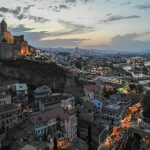
Back in Akhaltsikhe, Rabati Fortress showcases Georgia’s complex multicultural heritage through architecture spanning nine centuries. The massive complex underwent controversial restoration between 2011-2016, creating a somewhat Disneyland-like appearance that purists criticize. However, the restoration preserved structures that would have otherwise collapsed, while creating Georgia’s most comprehensive museum of regional history.
The fortress contains a Georgian Orthodox church, Catholic church, synagogue, and mosque within its walls – reflecting Akhaltsikhe’s role as a crossroads between Christian and Islamic civilizations. Each religious building represents different periods of local control, from medieval Georgian kingdoms through Ottoman rule to Russian imperial administration.
Entry costs 15 GEL and includes access to all buildings except the historical museum (additional 10 GEL). The museum’s highlight is a collection of medieval manuscripts rescued from monasteries across Samtskhe-Javakheti region. Many texts survived centuries hidden in cave churches, emerging only during recent archaeological surveys.
Architectural Highlights
The 9th-century Church of St. Marine represents the fortress’s oldest surviving structure. Its austere stone construction contrasts sharply with the ornate 16th-century Ahmedi Baba Mosque, built during Ottoman administration. The mosque’s minaret offers panoramic views across modern Akhaltsikhe toward the Javakheti Plateau.
The restored royal palace houses a restaurant and small hotel, though neither achieves particularly high standards. More interesting is the old hammam, where original heating systems demonstrate Ottoman-era engineering. The complex includes several souvenir shops selling local crafts at reasonable prices.
Regional Food Scene: Samtskhe-Javakheti Flavors
Southern Georgia’s cuisine reflects Armenian, Turkish, and Javakheti Armenian influences alongside traditional Georgian flavors. Local specialties include khashlama (slow-cooked lamb with herbs), Javakheti potatoes prepared dozens of different ways, and unique cheese varieties aged in mountain caves.

In Akhaltsikhe, Restaurant Gomi serves excellent traditional Georgian dishes in a restored 19th-century house near Rabati Fortress. Their khinkali arrive steaming hot with perfectly seasoned broth inside delicate dough pouches. Expect to pay 25-35 GEL per person for a full meal with wine.
Cafe Vardzia, despite its name, sits in central Akhaltsikhe rather than near the monastery. Their specialty is Samtskhe-style khachapuri made with local cheese and baked in a traditional tone oven. The cheese has a sharper flavor than typical Georgian varieties, reflecting highland dairy traditions. A khachapuri with Georgian tea costs around 12 GEL.
Local Specialties
Javakheti Armenians brought unique culinary traditions that evolved in isolation for generations. Their lavash differs from standard Georgian shotis puri, with a thinner texture perfect for wrapping grilled meats. Local markets sell lavash fresh from traditional ovens, often still warm at 2 GEL per stack.
The region produces excellent honey from wildflowers growing on volcanic soils. This honey has a distinctive mineral taste impossible to replicate elsewhere in Georgia. Local beekeepers sell directly at Akhaltsikhe’s Tuesday market, with prices starting at 15 GEL per kilogram for darker varieties.
Getting There and Around: Transportation Guide
Direct marshrutkas run from Tbilisi’s Didube bus station to Akhaltsikhe three times daily (09:00, 13:00, 17:00), taking four hours and costing 25 GEL. The route passes through Gori and Borjomi, making it possible to break the journey at either stop. Return schedules from Akhaltsikhe depart at 07:00, 11:00, and 15:30.
From Akhaltsikhe to Vardzia, public transport runs twice daily in summer months (May-October) at 10:00 and 14:00, returning at 13:00 and 17:00. The journey takes 1.5 hours each way and costs 8 GEL. In winter, service reduces to once daily, making day trips challenging without private transport.
Taxi drivers at Akhaltsikhe’s bus station charge 80-120 GEL for a round trip to Vardzia including 3 hours waiting time. This makes sense for groups of 3-4 people, especially when public transport schedules don’t align with your plans. Agree on the total price before departure and confirm waiting time at Vardzia.

Rental Cars and Self-Driving
The road from Akhaltsikhe to Vardzia improved significantly in 2025 with new asphalt surfaces replacing most rough sections. Any standard car can handle the route in good weather, though winter driving requires experience with mountain conditions. Rental cars from Tbilisi agencies (Budget, Hertz, local operators) cost 60-80 GEL daily for economy vehicles.
Parking at Vardzia is free and secure, with space for about 50 vehicles. The lot sits 200 meters from the cave entrance along a paved walkway. Fuel stations in Akhaltsikhe provide the last reliable petrol before Vardzia, though a small station in Aspindza offers emergency supplies.
Day Trip or Overnight? Planning Your Visit
Most travelers treat this region as a long day trip from Tbilisi or an overnight stop en route to Armenia. Both approaches work, depending on your interests and schedule constraints. Day trippers typically leave Tbilisi early morning, visit Vardzia, explore Rabati Fortress briefly, then return by evening marshrutka.
Staying overnight in Akhaltsikhe allows more relaxed exploration and better photography opportunities. Early morning light at Vardzia creates ideal conditions for photos without crowds, while evening visits to Rabati Fortress offer sunset views impossible during rushed day trips. Local guesthouses provide authentic experiences at reasonable prices.
Two-night stays make sense for travelers interested in hiking the Javakheti Plateau or visiting smaller cave monasteries near Vardzia. The region contains dozens of unexplored archaeological sites accessible only on foot or by 4×4 vehicle. Local guides in Akhaltsikhe arrange custom tours starting at 150 GEL per day.

Seasonal Considerations
Summer months (June-September) offer the most reliable transport schedules and best weather for cave exploration. However, July and August bring crowds to Vardzia during peak tourist season. Spring (April-May) and autumn (October-November) provide pleasant temperatures with fewer visitors, though public transport runs reduced schedules.
Winter visits require careful planning due to limited transport options and potential snow on the Javakheti Plateau. However, winter light in the cave churches creates dramatic effects impossible during other seasons, making the extra effort worthwhile for serious photographers.
Budget Breakdown: Southern Georgia Costs in 2026
Budget travelers can explore this region comfortably on 70-90 GEL per day, while mid-range visitors should budget 120-160 GEL daily. Comfortable stays with private guides and quality restaurants require 200-300 GEL per day.
Budget Range (70-90 GEL daily)
- Akhaltsikhe guesthouse: 40-50 GEL per night
- Marshrutka transport (Tbilisi-Akhaltsikhe-Vardzia): 33 GEL total
- Vardzia entrance: 15 GEL
- Rabati Fortress: 15 GEL
- Meals at local cafes: 25-30 GEL daily
Mid-Range (120-160 GEL daily)
- Hotel Rabati or similar: 120-140 GEL per night
- Shared taxi to Vardzia: 30-40 GEL per person
- Guided tour at Vardzia: 25 GEL
- Restaurant meals: 50-60 GEL daily
- Museum entries and extras: 25 GEL
Comfortable (200-300 GEL daily)
- Boutique accommodation: 180-250 GEL per night
- Private driver for the day: 120-150 GEL
- Premium dining: 80-100 GEL daily
- Private guides and special access tours: 100-150 GEL
These prices assume single travelers; couples sharing accommodation reduce per-person costs significantly. Group tours from Tbilisi agencies cost 180-220 GEL per person for day trips including transport, guide, and entrance fees.
Frequently Asked Questions
How much time should I allocate for Vardzia?
Plan 2-3 hours minimum for the main tourist route through Vardzia cave monastery. Photography enthusiasts and history buffs often spend 4-5 hours exploring thoroughly. Add travel time from Akhaltsikhe (3 hours total by marshrutka, 2 hours by private transport).

Is Vardzia suitable for children or elderly visitors?
The main tourist route includes steep stairs and narrow passages that may challenge young children or visitors with mobility issues. However, the lower levels and church areas remain accessible. The site provides no special facilities for disabled visitors as of 2026.
Can I visit Vardzia in winter months?
Yes, but with limited transport options. Winter marshrutka service runs only once daily, and weather can close the road during heavy snow. The caves stay relatively warm year-round, making winter visits comfortable once you arrive. Book accommodation and transport well in advance.
What should I bring for cave exploration?
Wear sturdy shoes with good grip for uneven stone surfaces. Bring a small flashlight for darker chambers, though the main route has adequate lighting. Dress in layers as cave temperatures stay cool even in summer. Camera batteries drain faster in cold cave conditions.
Are there other cave monasteries worth visiting in the region?
Yes, smaller cave complexes exist at Vanis Kvabebi (30 minutes from Vardzia) and near Khertvisi Fortress. These require longer hikes and have no tourist facilities, but offer authentic exploration experiences without crowds. Local guides in Akhaltsikhe arrange visits for 100-150 GEL per day.
📷 Featured image by Timur Kozmenko on Unsplash.