On this page
- Why Bodbe Still Stops Travelers in Their Tracks
- The Story Behind the Stones: Bodbe’s History
- Inside the Monastery Walls: What You’ll Actually See
- The Walk Down to St. Nino’s Sacred Spring
- The Views Over the Alazani Valley
- Getting to Bodbe from Sighnaghi
- Dress Code and Respectful Conduct
- When to Visit Bodbe: Seasons and Timing
- Pairing Bodbe with a Full Sighnaghi Day
- 2026 Budget Breakdown for a Bodbe Visit
- Practical Tips for Visiting Bodbe in 2026
- Frequently Asked Questions
💰 Click here to see Georgia Budget Breakdown
💰 Prices updated: October, 2026. Budget figures are estimates — always verify before travel.
Exchange Rate: $1 USD = ₾2.60
Daily Budget (per person)
Shoestring: ₾70.00 – ₾130.00 ($26.92 – $50.00)
Mid-range: ₾180.00 – ₾350.00 ($69.23 – $134.62)
Comfortable: ₾500.00 – ₾1,000.00 ($192.31 – $384.62)
Accommodation (per night)
Hostel/guesthouse: ₾30.00 – ₾60.00 ($11.54 – $23.08)
Mid-range hotel: ₾110.00 – ₾200.00 ($42.31 – $76.92)
Food (per meal)
Budget meal: ₾15.00 ($5.77)
Mid-range meal: ₾35.00 ($13.46)
Upscale meal: ₾100.00 ($38.46)
Transport
Single metro/bus trip: ₾1.00 ($0.38)
Monthly transport pass: ₾40.00 ($15.38)
Why Bodbe Still Stops Travelers in Their Tracks
Most visitors to Sighnaghi spend their time inside the walled town — wandering the cobblestone lanes, sipping wine at a guesthouse terrace, watching the sun set over the Alazani Valley. Bodbe Monastery sits just 2 kilometres south of those walls, and in 2026 it remains one of the most quietly powerful religious sites in the entire Caucasus. The challenge isn’t finding it — it’s convincing yourself to leave once you’re there. If you’re planning a trip to Kakheti and treating Bodbe as a quick checkbox stop between wine tastings, this guide will change your approach.
The Story Behind the Stones: Bodbe’s History
Bodbe is not simply old. It is foundational. This is the burial site of St. Nino, the Cappadocian woman who converted Georgia to Christianity in the early 4th century — around 337 AD — making Georgia one of the earliest nations in the world to adopt Christianity as a state religion. St. Nino is said to have spent her final years at Bodbe, living an ascetic life on this hillside above the Alazani plain, and she died and was buried here at her own request.
King Mirian III, whom St. Nino had converted, ordered a church built over her grave. What stands today evolved through centuries of construction, destruction, and restoration. The Persians ransacked the complex multiple times. By the medieval period, Bodbe had grown into a significant episcopal seat — the Bishops of Bodbe held considerable religious authority over Kakheti for centuries. The monastery was largely abandoned and fell into serious disrepair during the 19th century under Russian imperial rule, before being restored in the 1880s under the patronage of Queen Nino of Mingrelia.
In 1991, an active convent of nuns was established here, and that community continues to maintain the monastery today. Walking through the gates in 2026, you’re entering a living institution — not a museum. The nuns hold services, tend the gardens, and manage the steady flow of Georgian pilgrims who arrive year-round to venerate St. Nino’s tomb.

Inside the Monastery Walls: What You’ll Actually See
The monastery complex sits inside a walled enclosure on a forested hillside. The main structure is the Cathedral of St. Nino, a three-nave basilica with origins in the 4th century and its current form largely shaped by 9th and 17th-century construction. The interior is dim and fragrant with incense and candlewax — your eyes adjust slowly from the bright Kakheti sun outside. The tombs of St. Nino and several medieval bishops are housed here, marked by a richly decorated canopy. Georgian pilgrims queue to kiss the tomb and press small notes of prayer into the stone.
Beyond the cathedral, the grounds include:
- The bell tower — a distinctive multi-tiered structure visible from the approach road, dating to the 17th century
- The convent buildings — functioning residential quarters for the nuns, not open to visitors
- The walled gardens — immaculately maintained, planted with roses, lavender, and seasonal flowers that perfume the air in late spring
- A small icon and candle shop — run by the convent, selling hand-painted icons, beeswax candles, and monastery honey
The atmosphere inside the walls is unhurried and serious without being unwelcoming. Tourists and pilgrims mix quietly. The sound of chanting occasionally drifts from the cathedral during morning and evening services.
The Walk Down to St. Nino’s Sacred Spring
This is the part of Bodbe that most day-trippers skip — and they miss something genuinely memorable. From the monastery grounds, a marked path descends steeply through a forest of oak and hornbeam, dropping roughly 100 metres in elevation over about 800 metres of trail. The path is paved in sections but uneven, and it can be slippery after rain. Allow 15–20 minutes down and 25–30 minutes back up.
At the bottom, tucked into the hillside beside a small stream, is the sacred spring of St. Nino. The site has been developed over the years into a modest pilgrimage complex: there are several bathing pools separated into sections for men and women, fed by the cold spring water, and a small chapel. Georgian pilgrims immerse themselves fully in the water — it is a religious act of purification and healing, not a spa experience. The water temperature hovers around 10–12°C year-round. Bring a change of clothes and a small towel if you plan to participate. Non-Orthodox visitors are welcome to observe or enter the pools; there’s no pressure either way.
The descent through the trees, the sound of water growing louder as you approach, the sudden coolness of the shade after the open hilltop — this sensory shift is one of the more unexpected experiences Kakheti offers. It feels genuinely removed from the polished wine-tourism circuit just a few kilometres away.
The Views Over the Alazani Valley
The monastery sits at roughly 500 metres above sea level on the edge of the Tsiv-Gombori ridge. From the grounds and especially from the area near the entrance gate, the land drops away sharply toward the Alazani Valley floor, a broad expanse of vineyards, orchards, and flat agricultural land stretching toward the Caucasus foothills and, on clear days, the snow-capped peaks of the Greater Caucasus range on the horizon.
The views are outstanding in every season but genuinely extraordinary at two specific moments: early morning, when ground mist still fills the valley floor and the light comes from the east at a low angle, turning the vineyards gold; and in October during Rtveli (the grape harvest), when the valley is at full colour and harvest activity is visible below. In autumn the forest surrounding the monastery itself turns amber and copper, framing the stone buildings in a way that justifies every photograph.
There are no formal viewpoint platforms — the views are simply there, from the path and the garden walls. Find a spot on the stone wall near the entrance and give yourself 10 quiet minutes to look. It’s the kind of landscape that makes the noise of daily life feel very distant.
Getting to Bodbe from Sighnaghi
Bodbe is 2 kilometres from Sighnaghi’s main gate — close enough to walk in under 30 minutes on a flat, paved road, though the return involves a gradual uphill stretch back into town. In 2026, the road between Sighnaghi and Bodbe remains in good condition following resurfacing works completed in late 2024.
Walking: Exit Sighnaghi through the main lower gate and follow the signposted road south. The walk is pleasant and passes through quiet residential areas and small orchards. Allow 25–30 minutes at a comfortable pace.
Taxi: Any taxi in Sighnaghi will take you to Bodbe for 10–15 GEL one way. Many drivers will wait at the monastery for an agreed rate of around 30–40 GEL total including waiting time — useful if you plan to visit the spring and don’t want the uphill return walk.
Marshrutka: There is no dedicated marshrutka route from Sighnaghi to Bodbe. Marshrutkas running between Sighnaghi and Telavi pass the Bodbe junction on the main highway, but the monastery is a 10-minute uphill walk from that point. For most visitors, a taxi or walking from Sighnaghi town is more practical.
From Tbilisi: Bodbe is not a practical standalone day trip from Tbilisi — combine it with a Sighnaghi visit. The Tbilisi–Sighnaghi marshrutka departs from Ortachala bus station (currently running on a revised 2026 schedule — check locally for current departure times, which typically start from 09:00). The journey takes approximately 1.5–2 hours depending on stops. From Sighnaghi, walk or take a local taxi to Bodbe.
Dress Code and Respectful Conduct
Bodbe is an active convent, not a heritage attraction. The dress code is strictly observed and non-negotiable:
- Women must cover their heads inside the cathedral and wear skirts or dresses below the knee. Trouser-wearing visitors should wear a wrap skirt over them. Bare shoulders are not appropriate inside the church.
- Men must remove hats inside the cathedral and wear long trousers. Shorts are not acceptable.
- Wraps and head coverings are available to borrow at the entrance.
Photography inside the cathedral is generally not permitted during active services. Outside, in the garden and grounds, photography is fine. The nuns and monks at Georgian religious sites are accustomed to tourists but appreciate basic courtesy — keep voices low, step aside for worshippers approaching the tomb, and don’t treat the interior as a backdrop for social media content while prayers are in progress.
Purchasing a beeswax candle from the convent shop (typically 1–3 GEL) and lighting it inside the cathedral is a gesture of respect recognised across all faith traditions visiting Georgian churches. It also directly supports the convent community that maintains the site.
When to Visit Bodbe: Seasons and Timing
Spring (April–May) is outstanding. The gardens are in full bloom, the air is cool and clear, the Caucasus peaks are still snow-covered and visible, and crowds are modest outside of Orthodox Easter week, when Bodbe receives large numbers of Georgian pilgrims and queues at the tomb and spring can be significant.
Summer (June–August) brings the most tourists to Sighnaghi and Kakheti. Bodbe is busiest on weekends. Visit on weekday mornings before 10:00 for the quietest experience. The heat on the open grounds can be intense by midday in July and August.
Autumn (September–October) is the best overall season. Rtveli grape harvest activity fills the valley below, the forest turns colour, temperatures are comfortable (18–24°C in September), and the light is perfect for photography. This is when Bodbe earns every superlative.
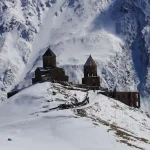
Winter (November–February) is the least visited period. The monastery is starkly beautiful under a light snowfall, the spring path is manageable in dry conditions but treacherous in ice, and the valley views on clear winter days can extend further than any other season. If you happen to be in Kakheti in winter, Bodbe in the snow is not a consolation prize.
Pairing Bodbe with a Full Sighnaghi Day
Bodbe and Sighnaghi together make one of the most complete single-day experiences in Georgia. Here’s a practical structure that works well:
- 08:00–09:00 — Arrive at Bodbe early. Walk the monastery grounds, enter the cathedral before the main visitor flow arrives.
- 09:00–10:30 — Descend to the sacred spring. Bathe or observe, then make the climb back up. This takes the most energy — do it while you’re fresh and the air is still cool.
- 10:30–11:00 — Walk back to Sighnaghi or take a taxi up.
- 11:00–13:00 — Explore Sighnaghi: the town walls, the History Museum, the viewpoint terraces.
- 13:00–15:00 — Lunch in Sighnaghi. The restaurants along the main street and the terrace below the Church of St. George offer meals with valley views.
- 15:00–17:00 — Wine tasting at one of Sighnaghi’s family wine cellars or at Pheasant’s Tears winery in the upper town.
- 17:00 onward — Evening stroll along the town walls as the light changes over the valley.
This itinerary works whether you’re staying in Sighnaghi overnight or making a long day trip from Tbilisi. If you’re doing the latter, aim to catch an early marshrutka to have enough time at Bodbe before the afternoon return.
2026 Budget Breakdown for a Bodbe Visit
Bodbe itself has no entrance fee. The monastery is open to all visitors at no cost. Your actual spend depends on how you get there, what you buy, and what you do in combination with Sighnaghi.
- Entry to Bodbe monastery: 0 GEL
- Candle from the convent shop: 1–3 GEL
- Icon or small monastery product: 15–80 GEL depending on size
- Monastery honey (small jar): 20–30 GEL
- Taxi from Sighnaghi (return, with waiting): 30–40 GEL
- Walking from Sighnaghi: 0 GEL
- Marshrutka Tbilisi–Sighnaghi (one way): 10–12 GEL per person
- Sighnaghi History Museum entry (if combining): 5 GEL
A realistic minimum spend for a Bodbe visit combined with a Sighnaghi day, including transport from Tbilisi, lunch, and basic entry costs: 60–90 GEL per person on a budget approach. A mid-range day with a wine tasting, sit-down lunch with wine, and return taxi comfort: 150–220 GEL per person.
Practical Tips for Visiting Bodbe in 2026
Opening hours: The monastery grounds are generally accessible from approximately 09:00 to 18:00, though the cathedral may open earlier for morning services (around 07:00–08:00). Evening services can extend access slightly later. There is no official posted schedule for tourist visits — the site operates on religious timing.
The spring path after rain: The descent to St. Nino’s spring becomes genuinely slippery in wet conditions. Wear shoes with grip. Flip-flops are not suitable for the trail under any conditions.
Water and food: There are no cafes or food sellers inside the monastery grounds. Bring water, especially in summer. The nearest food options are back in Sighnaghi.
Services schedule: Major religious services are held on Sunday mornings and on feast days associated with St. Nino (January 14 in the Georgian Orthodox calendar is the primary feast day, drawing large crowds). Visiting on these days offers an extraordinary atmosphere but requires patience with crowds.
Accessibility: The main monastery grounds are accessible to visitors with limited mobility on relatively flat paved paths. The spring descent is steep and uneven and is not suitable for wheelchairs or for visitors with significant mobility limitations.
Language: Signs at the monastery are in Georgian and increasingly in English as of 2026. The convent shop staff may have limited English; pointing and basic numbers are sufficient for purchases.
Connectivity: Mobile signal (Magti, Silknet, Beeline) is reliable at the monastery grounds. Signal weakens on the descent to the spring but returns at the bottom. Georgia’s mobile coverage in rural Kakheti improved significantly following 2024 infrastructure investment.
Frequently Asked Questions
Is Bodbe Monastery free to enter?
Yes, there is no admission fee to enter Bodbe Monastery. The site is maintained by the active convent of nuns and is open to visitors and pilgrims at no charge. Small donations through candle purchases at the convent shop are a conventional way to contribute to the upkeep of the site.
How far is Bodbe Monastery from Sighnaghi?
Bodbe is approximately 2 kilometres south of Sighnaghi along a paved road. Walking takes around 25–30 minutes from Sighnaghi’s main gate. A local taxi covers the distance in about 5 minutes and typically costs 10–15 GEL one way, or 30–40 GEL return with waiting time included.
Can non-Orthodox visitors bathe at the sacred spring?
Yes. Non-Orthodox visitors are welcome to use the bathing pools at St. Nino’s sacred spring. There is no requirement to be Orthodox or to follow any specific ritual. Bring a change of clothes and a towel. The water is cold year-round, around 10–12°C. Separate pools are provided for men and women.
What should women wear to visit Bodbe Monastery?
Women must cover their heads inside the cathedral and wear a skirt or dress below the knee. Wrap skirts and head coverings are available to borrow at the entrance if needed. Bare shoulders should be covered. These requirements apply inside the cathedral; the outdoor gardens have no strict dress enforcement, though modest clothing is appropriate throughout the site.
Can you visit Bodbe and Sighnaghi in one day from Tbilisi?
Yes, but you need an early start. Take the first morning marshrutka from Tbilisi’s Ortachala bus station (around 09:00), arriving in Sighnaghi by approximately 11:00. Head directly to Bodbe, spend 2–3 hours there including the spring walk, then explore Sighnaghi in the afternoon. Catch a return marshrutka by 17:00–18:00 to reach Tbilisi by early evening.
Explore more
The Ultimate Sighnaghi Travel Guide: Planning Your Trip to Georgia’s City of Love
Sighnaghi Nightlife: Your Ultimate Guide to Bars, Music & More
📷 Featured image by Collab Media on Unsplash.