On this page
- The Drive Everyone Talks About — and What Nobody Warns You About
- What the Georgian Military Highway Actually Is
- Road Conditions: What to Expect Season by Season
- Choosing the Right Vehicle for This Drive
- Leaving Tbilisi: The First Hour
- Scenic Stops Worth Pulling Over For
- The Jvari Pass Descent: The Section That Demands Full Attention
- Driving Safety: The Real Hazards
- Arriving in Stepantsminda
- 2026 Budget Breakdown: Costs for the Drive
- Practical Tips Before You Leave Tbilisi
- Frequently Asked Questions
💰 Click here to see Georgia Budget Breakdown
💰 Prices updated: October, 2026. Budget figures are estimates — always verify before travel.
Exchange Rate: $1 USD = ₾2.60
Daily Budget (per person)
Shoestring: ₾70.00 – ₾130.00 ($26.92 – $50.00)
Mid-range: ₾180.00 – ₾350.00 ($69.23 – $134.62)
Comfortable: ₾500.00 – ₾1,000.00 ($192.31 – $384.62)
Accommodation (per night)
Hostel/guesthouse: ₾30.00 – ₾60.00 ($11.54 – $23.08)
Mid-range hotel: ₾110.00 – ₾200.00 ($42.31 – $76.92)
Food (per meal)
Budget meal: ₾15.00 ($5.77)
Mid-range meal: ₾35.00 ($13.46)
Upscale meal: ₾100.00 ($38.46)
Transport
Single metro/bus trip: ₾1.00 ($0.38)
Monthly transport pass: ₾40.00 ($15.38)
The Drive Everyone Talks About — and What Nobody Warns You About
In 2026, more travelers than ever are renting cars in Tbilisi and pointing them north toward Kazbegi. It makes sense — the Georgian Military Highway is one of the most dramatic drives in the Caucasus, and the sense of arriving under your own power into Stepantsminda, with the Gergeti Trinity Church perched on its ridge above the valley, is something a marshrutka window seat simply cannot replicate. But the road has a reputation that runs in both directions. People either rave about it or arrive shaken. The difference almost always comes down to preparation. This guide covers the route honestly — the surface quality, the dangerous sections, the fuel logistics, the best stops, and the things that first-timers consistently get wrong.
What the Georgian Military Highway Actually Is
The Georgian Military Highway — known in Georgian as სამხედრო გზატკეცილი — runs roughly 212 kilometres from Tbilisi north through the Greater Caucasus Mountains to the Russian border at Larsi. Stepantsminda (Kazbegi) sits about 157 kilometres from central Tbilisi, making it the road’s most popular destination before the border crossing.
The route follows the Aragvi River north from Mtskheta, climbs through the resort town of Gudauri, crosses the Jvari Pass at 2,379 metres above sea level, then descends into the Terek River gorge and the village of Stepantsminda. It has served as a trade and military corridor for centuries. Today it’s Georgia’s only overland connection to Russia, which means it carries everything from tourist rental cars to Russian-registered trucks.
In 2026, the road is officially designated as highway S3. The Georgian Roads Department has continued a multi-year resurfacing programme along the route — most of the stretch between Tbilisi and Gudauri is in good condition with clear lane markings. The section from Gudauri to Stepantsminda remains more challenging, with ongoing rockfall management works near the Dariali Gorge.
Road Conditions: What to Expect Season by Season
The highway behaves very differently depending on when you drive it. Here’s what each season actually delivers.
Spring (March–May)
Early spring is the most unpredictable time on this road. Snowmelt causes rockfall and occasional landslides, particularly between the Jvari Pass and Stepantsminda. The pass itself may still be snow-covered in March and early April. By late May, conditions usually stabilise, and the valleys turn an almost absurd shade of green. Expect wet roads and some surface damage from the winter.
Summer (June–August)
The best driving conditions of the year. The road is dry, the pass is fully open, and visibility is good most days. Afternoon thunderstorms can appear quickly above 2,000 metres — pull over if one hits while you’re on the pass. This is peak season, so expect traffic, especially on weekends when Tbilisi residents make the drive in numbers.
Autumn (September–October)
Arguably the finest time to drive this road. Traffic drops, the light is golden, and the Caucasus forest turns red and amber above the gorge walls. Road conditions remain good through October. Snow can arrive at the pass in late October — check conditions if you’re traveling after the 20th.
Winter (November–February)
The road does not close entirely in winter — Gudauri operates as a ski resort and generates year-round traffic through the cold months. But the Jvari Pass section requires winter tyres (chains are sometimes mandatory) and closes periodically during storms. Ice forms on the descent from the pass toward Stepantsminda without much visual warning. If you don’t have winter driving experience, take a marshrutka instead. No view is worth a slide off a mountain road.
Choosing the Right Vehicle for This Drive
The most persistent question about driving to Kazbegi is whether you need a 4WD. In summer and autumn, a standard sedan handles the route without issue — the road surface, while not motorway-smooth, does not require off-road capability on the main highway. What you need is a car with decent ground clearance and reliable brakes. Small city cars with very low clearance can struggle on the potholes near the Dariali Gorge section.
In winter or early spring, or if you plan to take side roads (the track up toward Gergeti village, or the road to Truso Valley), a 4WD with winter tyres becomes genuinely necessary rather than optional.
Rental Tips for 2026
- Most reputable Tbilisi rental agencies now explicitly state whether their vehicles are permitted on the Military Highway. Always confirm this in writing — some budget rentals void insurance on mountain roads.
- Automatic transmission cars are available widely in Tbilisi in 2026. The long descents on this drive make manual gearbox skill useful but not essential.
- Rent from agencies with 24-hour roadside assistance coverage. Verify the number actually works before you leave the city.
- Fill the tank in Tbilisi. There are petrol stations in Gudauri and Stepantsminda, but fuel availability in Stepantsminda has been inconsistent — the Gudauri Wissol station is the reliable top-up point heading north.
Leaving Tbilisi: The First Hour
The drive begins on the E60/S3 highway heading northwest out of Tbilisi. The first 20 kilometres are straightforward dual carriageway through suburban Tbilisi and toward Mtskheta — Georgia’s ancient capital and the spiritual heart of the country. Most drivers stop here. The Svetitskhoveli Cathedral is right in the old town, and the Jvari Monastery sits on the ridge above the confluence of the Aragvi and Mtkvari rivers. Allow 45 minutes to an hour for Mtskheta if you want to walk through properly.
Past Mtskheta, the road narrows and turns north, following the Aragvi River valley. The landscape changes quickly — the dry hills around Tbilisi give way to steeper, greener gorge walls. The traffic here is a mix of local commuters, trucks heading to the Russian border, and tourist vehicles. Keep your speed reasonable on the two-lane stretches — overtaking opportunities are limited and some drivers take them aggressively.
Scenic Stops Worth Pulling Over For
The Military Highway is not a road to rush. These are the stops that genuinely reward the extra time.
Zhinvali Reservoir
About 65 kilometres north of Tbilisi, the road hugs the edge of this enormous turquoise reservoir, with its water colour sitting somewhere between jade and aquamarine depending on the season and the light. There are safe pull-off points on the western bank. On a clear morning, the reflection of the surrounding ridgeline in the still water is one of the most quietly beautiful sights on the entire route.
Ananuri Fortress
Directly on the reservoir’s northern shore, Ananuri is a 16th to 18th century fortress complex that should not be skipped. Entry costs around 3 GEL per person in 2026. Climb the square tower for a view over the reservoir and the valley ahead. The site is rarely crowded except on summer weekends, and the stonework — including the carved grapevine reliefs on the church façade — is genuinely striking up close.
Gudauri Viewpoint
As the road climbs toward Gudauri ski resort (elevation roughly 2,200 metres), there’s a famous Soviet-era semicircular mosaic viewpoint on the eastern side. The mosaic depicts Georgian-Russian friendship in classic Soviet style — historically interesting rather than beautiful — but the panorama of the Caucasus range from here is legitimate. This is where the scale of what you’re driving through finally becomes clear.
Jvari Pass (Cross Pass)
At 2,379 metres, the pass itself is marked by a small church and rows of crosses left by travelers. In clear conditions, the views north into the Terek gorge and south back toward the Gudauri plateau are extraordinary. The air here is noticeably thin. Even in July, the wind at the pass can be cold enough to need a jacket — keep one accessible rather than buried in luggage.
The Jvari Pass Descent: The Section That Demands Full Attention
The descent from Jvari Pass toward Stepantsminda is where the drive becomes serious. The road drops rapidly through a series of tight switchbacks carved into the gorge wall, with the Terek River appearing far below. The tarmac is narrower here, the drop on the outer edge is unguarded in places, and large trucks coming uphill take up more than their share of the road.
Drive in low gear. Do not ride the brakes continuously — this causes brake fade on a sustained descent. Engine braking through lower gears is the correct technique. If you’re driving an automatic, use the manual mode or the dedicated mountain/downhill mode if your car has one.
The Dariali Gorge section at the bottom is otherworldly — near-vertical rock walls close in on both sides, barely wide enough for the road and the river. The air smells of cold stone and rushing water, and the gorge blocks direct sunlight for much of the day, giving this stretch a dim, cathedral-like quality. It’s one of the most atmospheric kilometres on the entire Caucasus road network.
Driving Safety: The Real Hazards
The road has genuine risks. Understanding them specifically makes them manageable.
Marshrutka and Taxi Drivers
The shared minibuses and Kazbegi taxis that run this route daily are driven by people who know the road intimately. They also drive it fast. You will be overtaken on sections where overtaking looks impossible. Do not accelerate to prevent them passing — let them go. Matching their pace when you’re unfamiliar with the road is how accidents happen.
Rockfall Zones
Several sections of the road — particularly between the pass descent and Stepantsminda — run beneath unstable rock faces. Signs mark these zones. Don’t stop in them for photos. Move through them steadily rather than slowing to look up. After rainfall, the risk increases significantly.
Animals on the Road
Cattle, sheep, and dogs regularly use the road, particularly in the valley sections near villages. At dawn and dusk, visibility is low and animals are most active. A cow appearing around a blind corner at 70 km/h is not a theoretical risk on this road.
Fog at the Pass
Mountain fog can reduce visibility on the Jvari Pass to under 20 metres. If you’re caught in this, slow to a walking pace, use fog lights if you have them, and stop in a safe pull-off area until it clears. Fog on this pass typically moves quickly — rarely more than 30 minutes of genuine whiteout.
Arriving in Stepantsminda
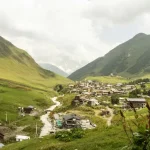
The town announces itself suddenly as the gorge opens up and the valley widens. Stepantsminda sits at around 1,740 metres elevation, ringed by peaks that top 4,000 metres. The Gergeti Trinity Church on its volcanic cone above the town is the first thing most people look for on arrival — it sits above the treeline on the left bank, and the sight of it from the main road, with Mount Kazbek behind it when the sky is clear, hits differently when you’ve just driven the whole route yourself.
Parking in central Stepantsminda is chaotic in peak season. The main street through town is narrow, and coaches and 4WDs compete for the same space. There’s an informal parking area near the bridge over the Terek — arrive before 10:00 to find space easily. If your accommodation is uphill from the main road, confirm access before assuming you can drive to the door.
The road into the upper part of town and toward Gergeti village is unpaved and rutted. It is manageable in a standard sedan when dry, but after rain it becomes slippery clay. The trail on foot from the main road to the church takes around 1.5 to 2 hours uphill — most visitors without a 4WD simply walk it.
2026 Budget Breakdown: Costs for the Drive
Here’s what a self-drive round trip from Tbilisi to Stepantsminda realistically costs in 2026.
- Car rental (per day, budget sedan): 80–120 GEL
- Car rental (per day, 4WD/SUV): 150–250 GEL
- Fuel (Tbilisi–Stepantsminda–Tbilisi, approximately 320 km): 60–90 GEL depending on vehicle
- Ananuri Fortress entry: 3 GEL per person
- Parking in Stepantsminda: 5–10 GEL informally collected at peak times
- Roadside food (churchkhela, bread, cheese at stops): 10–20 GEL
- Total driving cost per day (excluding accommodation): approximately 160–350 GEL depending on vehicle choice and group size
Splitting a rental between two or three people makes this one of the better-value ways to see the Kazbegi region compared to organised tours, which run 80–150 GEL per person but give you far less flexibility and time at each stop.
Practical Tips Before You Leave Tbilisi
- Download offline maps: Mobile signal disappears in the Dariali Gorge and several sections near the pass. Maps.me with the Georgia map downloaded works reliably. Google Maps offline also works for the main route.
- Carry cash: There is an ATM in Stepantsminda but it runs out during peak weekends. Withdraw in Tbilisi or Gudauri.
- Start early: Leaving Tbilisi by 07:00–08:00 gets you to Ananuri before tour groups arrive and onto the pass before afternoon weather builds. The drive with stops takes 4–5 hours without rushing.
- Vehicle documents: Carry your rental agreement, your driving licence, and your passport. Police checkpoints near the border area occasionally check documents, and rental agreements should explicitly permit the route.
- Emergency contacts: Georgian emergency number is 112. The Kazbegi municipality office number is worth saving if you’re staying multiple nights.
- Weather window: Check weather for both Tbilisi and Stepantsminda. Clear skies in the capital mean nothing if a front is sitting over the pass. Windy.com shows mountain elevation forecasts accurately.
Frequently Asked Questions
Is the Georgian Military Highway safe to drive in a regular car?
In summer and autumn, yes — a standard sedan handles the main highway to Stepantsminda without issue. The road to Gergeti village and several off-road detours require a 4WD. In winter or early spring, snow and ice on the Jvari Pass make a 4WD with winter tyres strongly advisable for anyone without extensive mountain driving experience.
How long does the drive from Tbilisi to Kazbegi take?
Without stops, roughly 2.5 to 3 hours in good conditions. With stops at Mtskheta, Ananuri, and the Gudauri viewpoint — which most people do — plan for 4 to 5 hours. Factor extra time if you’re traveling in peak summer when weekend traffic on the road is heavy.
Can I drive to Kazbegi in winter?
Yes, but with significant caveats. The Jvari Pass stays open most of the winter to serve Gudauri ski resort traffic, but it closes during severe storms — sometimes for 24 hours or more. Winter tyres are required by Georgian law in winter conditions. If you lack winter driving experience, a marshrutka from Tbilisi’s Didube terminal is the safer option.
Are there petrol stations on the route?
Yes, but not frequently. Fill up in Tbilisi before leaving. There’s a reliable Wissol station in Gudauri at around the 130 km mark. Stepantsminda has a small fuel point but supply is inconsistent at peak season. Plan your fuel stops around Gudauri rather than banking on Stepantsminda.
Do I need an international driving permit to drive in Georgia?
Citizens of EU countries, the UK, US, Canada, Australia, and many others can use their national driving licence in Georgia without an international permit — check the current list for your country before traveling. Your rental agreement should confirm the permitted driving area includes the Military Highway. Always carry your licence, passport, and rental documents together.
Explore more
Where to Go Out Late in Kazbegi: Your Guide to After-Hours Spots
📷 Featured image by Catherine Zaidova on Unsplash.