On this page
- What Orthodox Christmas Actually Is (and Why the Date Differs)
- Alilo: The Candlelit Procession That Defines 7 January in Georgia
- The Christmas Supra: Food, Drink, and the Table as Sacred Space
- Church Services and What to Expect as a Visitor
- Regional Celebrations: How Christmas Looks Outside Tbilisi
- 2026 Budget Reality: What Christmas in Georgia Costs
- Practical Planning: Logistics, Transport, and What Changes Over the Holiday
- Frequently Asked Questions
Most travelers arrive in Georgia in January 2026 having already celebrated Christmas on 25 December, and they walk into something they did not expect: a country mid-preparation for one of its most important holidays. Orthodox Christmas on 7 January is not a quieter or smaller version of what you just experienced at home. It is its own thing entirely — deeply rooted in the Georgian Orthodox Church, woven into national identity, and expressed with a combination of solemnity and joyful noise that catches first-time visitors completely off guard. If you are in Georgia between 5 and 8 January, this guide tells you exactly what is happening, why it matters, and how to be part of it without getting anything wrong.
What Orthodox Christmas Actually Is (and Why the Date Differs)
The date difference comes down to the calendar. The Georgian Orthodox Church, like the Russian, Serbian, and Jerusalem Orthodox churches, follows the Julian calendar for its religious year. The Julian calendar runs 13 days behind the Gregorian calendar that most of the world uses for everyday life. So what is 25 December on the Julian calendar lands on 7 January in Gregorian terms. This is not a Georgian quirk — it is a deliberate theological and historical position that the Georgian church has held for centuries.
Georgia takes this seriously at a national level. 7 January is a public holiday. So is 8 January, which is called Mtsignobarthukhutsesi — the Day of the Holy Archangels, observed immediately after Christmas. This two-day structure means the holiday has both a sacred evening (the night of 6–7 January) and a full day of family celebration on 7 January, followed by a quieter religious observation on the 8th. Many Georgians also observe Christmas Eve on 6 January with fasting and church attendance before the celebrations begin at midnight.
The Georgian Orthodox Church (the Apostolic Autocephalous Orthodox Church of Georgia) is one of the world’s oldest Christian institutions, claiming a foundation in the 4th century. Its Catholicos-Patriarch, currently Ilia II, has led the church since 1977 and remains an enormously respected figure across Georgian society. His public blessing during the Alilo procession in Tbilisi is one of the most watched moments of the entire Georgian religious calendar.
For travelers from Catholic or Protestant backgrounds, the most important thing to understand is that Orthodox Christmas is not primarily about gifts or commercial celebration. The spiritual core — the liturgy, the procession, the family gathering at the table — drives everything. Commercial elements exist, but they are secondary.
Alilo: The Candlelit Procession That Defines 7 January in Georgia
If you see one thing during Orthodox Christmas in Georgia, it should be Alilo. This is a Christmas procession that takes place on the morning of 7 January, and in Tbilisi it has grown into something extraordinary. Thousands of people — children, clergy, families, choir groups, people on horseback — move through the streets carrying candles, white flags, and icons. The word “Alilo” comes from the Hebrew “Hallelujah,” adapted into the Georgian carol tradition, and you will hear it sung in waves as the procession moves.
In Tbilisi, the main Alilo begins at the Holy Trinity Cathedral (Sameba), the largest cathedral in the Caucasus, and winds through the city toward the old town and Metekhi Church. The route changes slightly year to year depending on coordination with the city authorities, but the Sameba starting point is consistent. By 2026, the procession regularly draws between 20,000 and 40,000 participants and spectators. It is not a parade in the Western sense — there are no floats or commercial sponsors with banners. It is a moving act of collective worship, open and informal, and anyone can join by falling into step.
The atmosphere is unlike anything most Western travelers have experienced at a religious event. The sound builds as you get closer — polyphonic choral singing, the ringing of hand bells, the deep tones of a brass ensemble from a church choir. The smell of incense drifts from censers carried by deacons. Candle flames bob in the cold January air, and the breath of thousands of people rises in visible clouds in temperatures that typically sit between -2°C and 4°C at that time of morning.
Participants traditionally collect donations along the route — food, money, and small gifts — which are then distributed to the poor and to orphanages. This charitable dimension is embedded in the tradition. If someone approaches you as part of the procession and offers you a small symbolic gift (often a tangerine or a piece of bread), accepting it graciously is appropriate. You can also place a donation in the baskets carried by participants.
The Christmas Supra: Food, Drink, and the Table as Sacred Space
Christmas Day in Georgia means the supra — the Georgian feast table. After the fasting of Christmas Eve and the spiritual intensity of the church service or procession, the family gathers to eat. This is not a quick meal. A Georgian supra at Christmas can last four or five hours, and the table is a form of expression in itself.
The dishes served at a Christmas supra are largely the same ones that appear at any major Georgian feast, but the context makes them feel different. Satsivi is particularly associated with winter celebrations — it is cold chicken or turkey served in a rich walnut sauce seasoned with blue fenugreek, garlic, cinnamon, and cloves. The deep, aromatic heaviness of satsivi is a cold-weather dish through and through, and you will find it on almost every Christmas table. Gozinaki is the signature Christmas sweet: thin sheets of caramelized honey and walnuts, pressed flat and cut into diamond shapes. It is crunchy, intensely sweet, and sticky in a way that lingers pleasantly.

Beyond those seasonal staples, a Christmas supra will typically include badrijani nigvzit (aubergine rolls filled with spiced walnut paste), pkhali (compressed vegetable and walnut balls, usually with spinach or beetroot), lobiani (flatbread stuffed with spiced kidney beans), various pickled vegetables, and the centrepiece meats — usually roast pork or turkey. Khinkali, the large twisted soup dumplings, often appear as well, though they are more common at informal supras than formal ones.
The tamada — the toastmaster — leads the supra. At a Christmas table, the first toast is always to God and to the birth of Christ. The structure of toasts that follows is not improvised; it follows a traditional order that moves from the divine to country, to family, to guests. If you are invited to a Georgian family’s Christmas supra as a traveler, you are being offered something significant. The guest, in Georgian tradition, is sent from God — mehman Ghvtisaa. Sitting at that table places you inside the most important hospitality tradition in the country.
Wine is central. Georgian wine — made from Saperavi grapes in Kakheti, or white Rkatsiteli aged in qvevri clay amphoras — accompanies every toast. Chacha, the Georgian grape spirit, appears at the end of the meal. Refusing to drink is acceptable if you explain you do not drink alcohol; refusing to participate in the toast itself is not ideal. You can raise a glass of mineral water and the gesture is understood.
Church Services and What to Expect as a Visitor
Georgian Orthodox church services at Christmas are long by Western standards. The main liturgy on the night of 6–7 January typically begins around 23:00 and continues past midnight, marking the moment of Christ’s birth. Morning liturgies on 7 January begin around 08:00 or 09:00 at most churches. Both services are open to visitors.
The interior of a Georgian Orthodox church is something to stand inside quietly for a moment before your eyes adjust. Candles are the primary light source in many older churches — beeswax candles sold at the entrance for a few lari each, lit and placed in sand trays before icons. The golden flicker across ancient frescoes, the heavy smell of incense and wax, the sound of a choir singing in three-part harmony — this is not background atmosphere. For Georgian worshippers, this is the whole point.
Several rules apply for all visitors to Georgian churches, and they apply especially at Christmas when the churches are full:
- Women must cover their heads. Headscarves are often available at the entrance for a small donation, but bring your own to be certain. A shawl works perfectly.
- Shoulders and knees should be covered for both men and women. January temperatures mean this is rarely a problem, but check your layers before entering.
- Men should remove hats inside the church.
- Photography during active services is disrespectful and often prohibited. Observe the service. Photographs of the interior can be taken when the church is quiet, usually after the main liturgy ends.
- Seating is limited or absent in most Georgian churches. Worshippers stand for the entire service. If you cannot stand for long, position yourself near a wall or pillar where you can lean slightly.
- Move quietly if you enter or exit during the service. People are in prayer.
The churches worth attending for their setting and atmosphere at Christmas include Sameba Cathedral in Tbilisi (the largest, most dramatic), Metekhi Church on its cliff above the Mtkvari River, Anchiskhati Basilica (Tbilisi’s oldest surviving church, in the old town), and Alaverdi Cathedral in the Kakheti region if you are travelling outside the capital.
Regional Celebrations: How Christmas Looks Outside Tbilisi
Tbilisi’s Alilo is the most photographed and the most attended, but Christmas in Georgia extends well beyond the capital, and some of the most authentic celebrations happen in smaller towns and rural areas where the community is tighter and the traditions run deeper.
In Kakheti, the wine region to the east of Tbilisi, Orthodox Christmas coincides with the deep quiet of winter between the grape harvest and the spring pruning. Villages like Sighnaghi, Telavi, and Gremi observe Christmas with local Alilo processions that are noticeably more intimate — a few hundred people rather than tens of thousands, with the same structure but a closeness that Tbilisi cannot replicate. The Alaverdi Cathedral near Telavi, one of the most important religious sites in Georgia, holds its Christmas liturgy in a setting that has been sacred for over a thousand years.
In Kutaisi, Western Georgia’s largest city, the Christmas procession moves from the Gelati Monastery area toward the city centre. Gelati itself — a UNESCO World Heritage site and the burial place of King David the Builder — is a remarkable place to be on Christmas morning. The Byzantine-influenced mosaics inside the main church take on particular weight when surrounded by candlelight and choral singing.
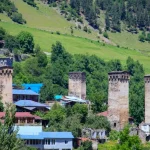
In mountain communities — particularly in Svaneti and the villages of the Greater Caucasus foothills — Christmas blends with older local traditions that predate Georgian Christianity in some cases. Pagan-adjacent winter customs persist alongside Orthodox practice in ways that church authorities have long since accepted as part of regional identity. If you are in Mestia in early January, the combination of deep snow, medieval stone towers, and Christmas church bells is something you will not find anywhere else on earth.
Batumi on the Black Sea coast has a more mixed religious population — Georgian Orthodox, Muslim, and Adjarian communities — but the Christmas celebrations in the Georgian Orthodox churches there are sincere and well-attended. The coastal temperature in January (typically 6°C to 10°C, significantly warmer than Tbilisi) makes Batumi a comfortable base for travelers who want Christmas in Georgia without the capital’s crowd intensity.
2026 Budget Reality: What Christmas in Georgia Costs
January is shoulder season in Georgia, which works in travelers’ favor. The Christmas holiday itself does not drive major price spikes the way New Year’s Eve (31 December / 1 January) does. That said, the period from 4–9 January sees higher-than-usual domestic travel as Georgians visit family, so transport and some accommodation books up faster than expected.
Accommodation (per night, Tbilisi)
- Budget (hostel dorm or guesthouse): 40–80 GEL
- Mid-range (3-star hotel or well-rated apartment rental): 130–220 GEL
- Comfortable (4-star boutique hotel, old town or Vera district): 280–450 GEL
Food and Drink
- Budget meal (local canteen or bakery — khachapuri and tea): 12–18 GEL
- Mid-range restaurant meal (two courses, Georgian wine by the glass): 45–80 GEL per person
- Comfortable dinner with wine (four-course supra-style meal): 120–180 GEL per person
- A bottle of good Saperavi from a wine shop: 25–60 GEL
- Gozinaki from a market stall: 8–15 GEL per portion
Transport
- Metro ride in Tbilisi: 1 GEL (Tbilisi Metro’s updated fare structure, in effect since the 2025 integration of the new Saburtalo extension, uses a single flat fare)
- Bolt or Yandex Go across central Tbilisi: 8–20 GEL depending on distance and surge
- Marshrutka (minibus) Tbilisi to Sighnaghi: 10–15 GEL
- Georgian Railway Tbilisi to Batumi (fast train): 29–45 GEL depending on class and booking time
- Tbilisi to Kutaisi by marshrutka: 12–18 GEL
What is free
Attending Alilo costs nothing. Entering Georgian Orthodox churches costs nothing (candles are optional and cost 1–3 GEL each). Standing at a public Christmas service is free. Much of what makes Orthodox Christmas in Georgia remarkable — the procession, the singing, the church interiors — is entirely open to any visitor who shows up with appropriate clothing and respectful attention.
Practical Planning: Logistics, Transport, and What Changes Over the Holiday
Georgia’s public holidays on 7 and 8 January create a specific pattern of closures and altered schedules that travelers need to account for.
Banks and government offices are closed on 7 and 8 January. ATMs operate normally, and the Georgian banking system’s card infrastructure is reliable in cities, but carry some GEL cash before 7 January in case you need it in a smaller town where ATM coverage is thinner.
Supermarkets and larger shops in Tbilisi generally remain open on 7 January with reduced hours, often 10:00–18:00. Smaller family-owned shops may be closed entirely as owners attend church and supra. Stock up on anything you need on 5 or 6 January.
Georgian Railway runs a holiday schedule on 7–8 January. In 2026, the Tbilisi–Batumi fast train continues to operate on both holidays, but with a reduced number of daily departures. Book tickets in advance through the Georgian Railway website or app — the period from 5–9 January sees higher than usual domestic passenger volumes. The Tbilisi–Kutaisi route via the new Gori bypass (operational since late 2025) also maintains service but on a reduced timetable.
Flights to and from Tbilisi International Airport and Kutaisi International Airport operate normally on 7–8 January. The expanded direct routes from European cities introduced in 2025–2026 (including increased frequency from Warsaw, Vienna, and Tel Aviv) mean January is more accessible than it was two years ago. Check your carrier’s specific schedule, as some low-cost operators reduce frequency in January regardless of the holiday.
The e-visa system for Georgia (updated in late 2024 to a streamlined single-portal process at evisa.gov.ge) processes applications year-round including over the holidays. The processing time remains approximately one business day, but if you are applying close to 7 January, submit by 4 January to avoid any potential delays caused by reduced government staffing.
Weather in Tbilisi in early January averages between -1°C and 6°C. Rain is more common than snow in the city itself, though the surrounding hills often carry snow. Dress in proper winter layers. The Alilo procession happens regardless of rain, and participants do not stop for weather.
If you are invited to someone’s home for Christmas, a small gift is appropriate — a good bottle of wine (Georgian, ideally), a box of chocolates, or flowers (an odd number; even numbers are for funerals). Arriving on time is fine, but Georgian supras often begin later than stated. Do not be surprised if a 14:00 lunch starts at 15:30. The table is ready when it is ready.
Frequently Asked Questions
Can non-Orthodox travelers attend Georgian Orthodox Christmas services?
Yes, Georgian Orthodox churches are open to all visitors during Christmas services. You are expected to dress appropriately — women with covered heads and covered shoulders, no bare knees for anyone — and to remain quiet and respectful. You are a witness to active worship, not a tourist attraction. Most Georgians welcome curious, respectful visitors without issue.
Is 7 January a full public holiday in Georgia? Will things be closed?
Both 7 and 8 January are public holidays in Georgia. Banks, government offices, and many smaller shops close. Larger supermarkets and most restaurants operate with reduced hours. Transport (buses, metro, trains, taxis) continues running. Plan your errands for 5 or 6 January if you need reliable access to services.
Where is the best place in Georgia to experience Orthodox Christmas?
Tbilisi offers the largest and most dramatic Alilo procession, centred on Sameba Cathedral. For something more intimate, Sighnaghi or Telavi in Kakheti give you a village-scale celebration with genuine community warmth. Mestia in Svaneti is extraordinary for atmosphere but requires winter-weather planning and limited accommodation availability in early January.
What is Alilo, and can tourists participate?
Alilo is a Christmas morning procession rooted in the tradition of caroling and charitable giving. Participants carry candles, icons, and white flags while singing Christmas carols. Anyone can join by walking alongside the procession. There is no registration or ticket. You can donate to the charitable baskets carried along the route if you wish to contribute.
Do Georgians celebrate Christmas on 25 December as well as 7 January?
Most Georgians observe only 7 January as Christmas, following the Georgian Orthodox calendar. The 25 December date has no official religious or public holiday status in Georgia. Some internationally-minded Georgians acknowledge it informally, and international hotels may offer 25 December events for foreign guests, but the national celebration is entirely centred on 7 January.
📷 Featured image by Yvette de Wit on Unsplash.