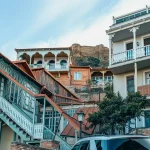
In 2026, Georgia is easier to visit than ever. English signs are everywhere, ride apps work in seconds, and new low-cost routes into Tbilisi and Kutaisi have brought more visitors than in 2024. The downside is that you can now tick off every major sight without having one real conversation with a local. The fix is simple and cheap: learn twenty words of Georgian and use them.
Why Words Open Doors in Georgia
Georgian is a Kartvelian language. It is its own family, unrelated to Russian, Turkish, Armenian or any Indo-European language. It has its own alphabet, Mkhedruli, with 33 curved letters that look like decoration until you learn to read them. Because Georgian is so unusual, locals do not expect foreigners to speak it. That is exactly why even a clumsy attempt gets such a warm reaction.
Georgian hospitality is built on the idea that a guest is a gift from God. Your effort with the language shows you are a guest, not just a customer. Doors open, extra plates arrive, and invitations appear.
Greetings That Change Everything
Start every interaction with a greeting before you ask for anything. In Georgia, skipping this feels abrupt.
- Gamarjoba (gah-mar-JO-bah): hello. The literal sense is “victory.” The reply is gagimarjos (gah-gee-MAR-jos), “victory to you.”
- Dilamshvidobisa (dee-lah-mshvee-DOH-bee-sah): good morning. It is long, but people smile when you try.
- Rogor khar? (RO-gor khar): how are you? Answer kargad var (KAR-gad var), “I’m fine.”
- Madloba (mad-LO-bah): thanks. Use gmadlobt (g-mad-LOBT) for elders or formal situations, and didi madloba for “thank you very much.”
- Ki (kee): yes. Ara (AH-rah): no.
- Nakhvamdis (nakh-VAM-dees): goodbye.
- Bodishi (bo-DEE-shee): sorry or excuse me.
Georgian has sounds English lacks. Letters like kh and gh come from the back of the throat, and some consonants are sharp “ejective” clicks. Do not worry. Locals will understand you, and they will often correct you kindly, which is the start of a lesson.
Surviving and Enjoying the Supra
The supra is the traditional Georgian feast, and it is the best cultural classroom in the country. The tamada, the toastmaster, leads the table through a series of toasts: to peace, to parents, to those who have passed, to guests. You do not drink casually between toasts. You wait, you listen, and you raise your glass at the right moment.
The words you need are few:
- Gaumarjos! (gow-MAR-jos): cheers, literally “to victory.”
- Sakartvelos gaumarjos! (sah-KART-vel-os gow-MAR-jos): to Georgia’s victory, a classic toast.
- Gemrielia (gem-ree-EH-lee-ah): it’s delicious. Say dzalian gemrielia for “very delicious.”
- Genatsvale (geh-nah-TSVAH-leh): a warm “dear” or “my friend” used between people who like each other.
Picture a long wooden table in a village courtyard, steam rising from a plate of khinkali, the tang of cold white wine in a clay cup. The tamada stands and the table goes quiet. You say “gaumarjos” with everyone else. That small moment of belonging is what “beyond the sights” really means.
Harvest, Wine and Village Life
Georgia’s wine culture is one of the oldest in the world, and the vocabulary is part of the experience. Ghvino (GHVEE-no) is wine. Qvevri (KVEH-vree) is the buried clay vessel used for fermenting and ageing it. Venakhi (veh-NAH-khee) means vineyard. Chacha (CHAH-chah) is the strong grape spirit offered at the end of a long meal, and refusing it outright can feel rude, so a polite sip is wise.
The best time to use these words is Rtveli, the grape harvest, which runs roughly from September into October, mainly in Kakheti. Many family wineries and guesthouses welcome visitors to pick grapes, crush them with their feet or help seal a qvevri. Imagine the sweet, sticky smell of crushed grapes on your hands and the cool air of a cellar lit by a single bulb. You will not forget it.
In a village home, useful phrases include sad aris…? (sahd AH-ris), “where is…?”, and ar mesmis (ar MES-mees), “I don’t understand.” Say the second one with a smile and someone will find a way to explain, often with gestures, a phone translator or a cousin who studied English.
Churches, Songs and Polite Questions
Orthodox Christianity shapes daily life. At monasteries and churches, women should cover their heads and wear a long skirt or wrap, and everyone should cover shoulders and knees. Scarves and wraps are usually offered at the door. Men remove hats. Inside, speak quietly and do not turn your back to the altar when leaving if you can help it.
Before you take a photo of a priest, a singer or a stranger, ask: shemidzlia? (sheh-MEED-zlee-ah), “may I?” Point at your camera. A yes is almost always followed by a smile.
Georgian polyphonic singing is on UNESCO’s intangible heritage list. It is three-part harmony, often unaccompanied, with a raw, resonant sound that fills a stone room. Many regions teach their own styles, and short workshops let you learn a simple folk song line by line. You do not need to read music. You need to listen closely and sing when the person beside you does.
Reading the Mkhedruli Script
Here is a practical trick that works in 2026: learn to read just ten or fifteen letters. Many road signs, menus and metro stations show Georgian and Latin script together, so you can match the two and decode words quickly. After one evening, you will start recognising place names, dish names and shop signs.
Offline translation apps now handle Georgian camera translation much better than they did in 2024, but they still stumble on handwritten menus and older signs. Reading a few letters yourself fills the gap. It also earns you a surprised compliment from the next taxi driver or café owner.
The words for numbers help a lot: erti (EHR-tee) one, ori (OH-ree) two, sami (SAH-mee) three. To ask a price, say ra ghirs? (rah GHEERS), “how much does it cost?”
2026 Budget Reality
Immersive experiences do not need a large budget. These are typical 2026 ranges in Georgian lari (GEL).
- Budget: a free language exchange meetup or a hostel-hosted evening (0–20 GEL), online Georgian lessons (30–45 GEL per hour), grape picking at a small family farm in return for lunch (0–60 GEL), a homemade supra at a basic guesthouse (50–80 GEL per person with house wine).
- Mid-range: a polyphonic singing workshop (60–120 GEL), a cooking class covering khinkali or khachapuri (90–150 GEL), a village homestay with dinner and breakfast (120–200 GEL per night), a guided Rtveli day with transport (150–250 GEL).
- Comfortable: private Georgian lessons with a local tutor in your city (60–100 GEL per hour), a full-day private cultural tour with a driver and translator (350–600 GEL), a boutique winery stay with harvest participation and a tamada-led supra (250–450 GEL per person per night).
Prices rise during the Rtveli season and around Tbilisoba in October, so book homestays and workshops a few weeks ahead. Most guesthouses accept cash in lari, and card payment is now common in cities but less reliable in villages.
Frequently Asked Questions
Do I need to speak Georgian to travel in Georgia?
No. English is widely spoken in Tbilisi, Batumi and tourist areas, and many younger Georgians speak it well. In villages and mountain regions, English is less common. Learning basic phrases like gamarjoba and madloba makes travel smoother and often leads to warmer, more generous interactions with locals.
Is Georgian similar to Russian or Armenian?
No. Georgian belongs to the Kartvelian language family, which is separate from Russian, Armenian and every Indo-European language. It also has its own script, Mkhedruli. Some Russian is understood by older Georgians, but speaking Georgian, even badly, is more appreciated than using Russian.
What is the most useful Georgian phrase for visitors?
Gamarjoba, meaning “hello,” is the most useful. Use it every time you enter a shop, taxi, guesthouse or home. After that, madloba (“thanks”) and gaumarjos (“cheers”) carry you through most social situations. Greeting first signals respect and usually improves how people treat you.
How should I behave at a supra?
Wait for the tamada’s toasts before drinking, and do not clink glasses until the toast is finished. Try a little of each dish, praise the food, and do not refuse hospitality abruptly. If you cannot drink alcohol, say so politely and hold a glass of juice or water during toasts.
When is the best time to join a wine harvest?
Rtveli usually runs from September through October, depending on the region and the year’s weather. Kakheti is the main wine region, and many family wineries welcome visitors. Book ahead in 2026, as accommodation near Telavi and Sighnaghi fills quickly during peak harvest weeks.
📷 Featured image by Portraits of Modern Dairy on Unsplash.