On this page
- Daily Safety: What Crime Actually Looks Like in Georgian Cities
- The Political Situation in 2026: Protests and What They Mean for You
- Places to Avoid: Occupied Territories and Border Zones
- Roads, Taxis and Getting Around Safely
- Mountain and Nature Risks for Weekend Trips
- Health Safety: Insurance, Clinics and Pharmacies
- Safety for Women, LGBTQ+ Travellers and Visitors of Colour
- Legal and Financial Safety for Long-Stay Remote Workers
- 2026 Safety Budget: What Staying Safe Costs
- Frequently Asked Questions
Open any news feed in 2026 and you may see photos of tear gas on Rustaveli Avenue, then wonder whether it is smart to move your laptop life to Georgia for a few months. The headlines and the daily reality do not match as neatly as you might expect. Georgia remains one of the safer countries in the region for foreign remote workers, but “safe” here comes with specific details. This guide covers the real risks, the overblown ones, and the practical steps that make a 1–6 month stay smooth.
Daily Safety: What Crime Actually Looks Like in Georgian Cities
Violent crime against foreigners is rare in Tbilisi, Batumi and Kutaisi. Walking home at midnight after dinner is normal for locals and residents alike. You will see families in parks late in the evening and teenagers on benches long after dark.
The problems you are more likely to meet are small ones:
- Pickpocketing on crowded metro cars, minibuses (marshrutkas) and at busy markets.
- Phone snatching in tourist-heavy areas, usually when someone holds a phone loosely near a road.
- Bag theft from café chairs and train luggage racks.
- Overcharging by unmetered taxis at airports and train stations.
Tbilisi’s metro is clean and cheap, but at rush hour the carriage becomes a tight crush of coats and bags. Keep your phone in a front pocket and your backpack on your chest. This is the same habit you would use in Barcelona or Istanbul, and it solves almost every theft story you will hear.
Batumi needs extra care in summer. Beachfront crowds swell, and opportunistic theft goes up. In winter the city feels quiet, and the main hazards become wet marble pavements and gusty sea wind.
The Political Situation in 2026: Protests and What They Mean for You
Since late 2024, Georgia has seen large and often tense demonstrations against government decisions, centred on Tbilisi’s Rustaveli Avenue. New laws on foreign funding, public assembly and media have sharpened the debate. Police have used water cannon, pepper spray and detentions at some protests, and fines for protest-related offences have risen.
For a remote worker, the practical picture looks like this:
- Protests are concentrated in a small central area, usually in the evening. Most of Tbilisi carries on normally.
- Foreigners who join protests carry extra risk. A detention can complicate your visa-free status, and officials can refuse entry to people they see as a problem.
- The safest approach is to watch from a distance or avoid the area during large events. Do not film police up close.
- Do not post political content from Georgian soil without thinking it through. Rules on “foreign agents” and public order are strict and unevenly applied.
Your government’s travel advisory is worth reading before you book. Many Western countries list Georgia at a normal or “exercise increased caution” level because of the political tension and the occupied regions. Register with your embassy’s traveller programme so they can reach you if something changes.
Places to Avoid: Occupied Territories and Border Zones
Abkhazia and the former South Ossetia region (Tskhinvali region) are controlled by Russia-backed authorities. Georgian law treats entry from the Russian side as illegal. Entry from the Georgian side is practically closed to foreigners, and crossing without permission can lead to detention.
The Administrative Boundary Lines (ABL) are not marked like normal borders. Near Gori and parts of the Shida Kartli region, some roads end at fences, watchtowers or “borderisation” signs. Do not walk or drive off the main road in these zones. Your phone map may not show where the line runs.
The border with Azerbaijan around the David Gareja monastery complex is also a sensitive area. Stay on marked paths and follow guard instructions. Tourists visit daily without trouble, but it is not a place for casual wandering past a marker.
Roads, Taxis and Getting Around Safely
The biggest real danger to foreigners in Georgia is traffic. Drivers overtake on blind bends, ignore lane markings and treat pedestrian crossings as suggestions. In cities, cross at lights where possible and make eye contact with drivers before stepping out.
For getting around:
- Ride-hailing apps such as Bolt and Yandex Go show the price up front and track your route. They also remove the language barrier and the haggling.
- Street taxis without a meter should be avoided unless you agree the price before getting in.
- Minibuses and trains are safe, if crowded. The Tbilisi–Batumi express trains are comfortable and far safer than driving the same distance.
- Renting a car is fine if you are an experienced driver. Expect livestock on rural roads, potholes after winter and fast, tight driving on the main highway between Tbilisi and Kutaisi.
- Scooters and e-bikes are risky. Many hospital visits from tourists come from scooter falls, and most travel insurance excludes them without a licence.
Stray dogs are common in every city. Most are calm and tagged by the municipality, but avoid petting dogs without a tag and keep a distance from packs at night. If you plan a long stay, a rabies pre-exposure vaccine is worth a conversation with your doctor.
Mountain and Nature Risks for Weekend Trips
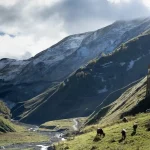
Georgia’s mountains are the reason many remote workers stay longer than planned. They are also where safety problems get serious. Picture the crunch of fresh snow on the path above Stepantsminda at dawn, with the Caucasus ridge turning pink. That is a beautiful moment, and one where weather can change within an hour.
Know these risks before a weekend trip:
- Avalanches and road closures hit the Gudauri–Kazbegi road in winter. Check the road status before you set out, and accept delays.
- Mobile signal can disappear on high trails in Svaneti and Tusheti. Download offline maps and tell someone your route.
- Weather changes fast. Even in July, temperatures can drop below 5°C at altitude after sunset.
- Remote roads to Tusheti and Upper Svaneti need a 4×4 and an experienced local driver.
- Earthquakes happen but are usually minor. Buildings in the cities are mostly sound, though some Soviet-era blocks are older.
The rescue service responds through the national emergency number, 112. Response in the mountains can be slow, so hire a licensed guide for anything above a simple day hike.
Health Safety: Insurance, Clinics and Pharmacies
Healthcare in the big cities is good for routine problems. Private clinics in Tbilisi and Batumi are modern, English is widely spoken at the front desk, and a GP visit usually costs less than in Western Europe. Serious cases may need transfer to a larger hospital, and evacuation abroad is expensive without cover.
Health insurance is a requirement for some residence and programme routes, and a very smart purchase for everyone else. Georgia’s visa-free year does not give you access to public healthcare. Without insurance, a night in a private hospital can cost thousands of lari.
- Pharmacies are everywhere and sell many drugs without a prescription. Check brand names and expiry dates, and bring any regular medication in its original packaging with a doctor’s note.
- Tap water in Tbilisi is generally drinkable, though many residents filter it. In smaller towns and during summer, buy bottled water if you are unsure.
- Tbilisi has winter air-pollution days with traffic haze. If you have asthma, check an air-quality app and consider a mask on bad days.
- Food hygiene is good, though a street khachapuri in peak summer heat is not a gamble worth taking if it has sat for hours.
Safety for Women, LGBTQ+ Travellers and Visitors of Colour
Solo women generally report feeling safe in Georgia. Staring and unwanted comments happen, especially in smaller towns, but physical harassment is uncommon. Use ride-hailing apps late at night, share your live location with a friend, and trust your instincts as you would anywhere.
LGBTQ+ travellers should be realistic. Georgia has no legal ban on being gay, but social attitudes are conservative, and recent “family values” legislation has made the climate harder. Public affection can draw hostile attention. Many LGBTQ+ remote workers live quietly in Tbilisi and Batumi without trouble, but discretion in public is the wise choice.
Visitors of colour may face curiosity or staring, particularly outside Tbilisi. Racist incidents are not common, but they do occur, and some people report harassment. Local expat groups share up-to-date advice on landlords and neighbourhoods that are welcoming.
Legal and Financial Safety for Long-Stay Remote Workers
Safety is also about your paperwork and your money. Citizens of about 95 countries can stay in Georgia visa-free for up to one year. Count your days carefully, because overstaying brings fines and possible entry bans. Keep screenshots of your entry stamp date or e-record.
On tax, Georgia’s 1% small business regime lets individual entrepreneurs pay 1% on turnover up to GEL 500,000 a year. Registration is done through the Revenue Service and is free. It makes sense if you are staying long enough to build a local tax history, but get advice from a Georgian accountant about your home country’s rules. Staying beyond 183 days in a calendar year can create tax residency.
The Remotely from Georgia programme, designed for foreign remote workers, has asked for proof of remote employment or self-employment, health insurance and a minimum monthly income. Requirements change, so confirm the current terms on the official government portal before you plan around it.
For money safety:
- Use ATMs inside banks rather than standalone machines on the street.
- Only change money at banks or well-reviewed exchange offices. Avoid anyone offering a better rate on the street.
- Rental scams exist. Never pay a deposit before you see the flat, and insist on a written contract in English or Georgian that states the deposit terms.
- Use a VPN on public Wi-Fi and keep two-factor authentication on your banking apps.
2026 Safety Budget: What Staying Safe Costs
Safety costs are modest compared with Western Europe. These figures are typical 2026 ranges and can vary by season and city.
- Budget: Basic nomad health insurance at roughly GEL 80–150 a month, a studio in Kutaisi at about GEL 600–1,000, Bolt or Yandex Go rides at GEL 5–12 across town, and a local SIM at GEL 15–30 a month.
- Mid-range: Comprehensive insurance with trekking and evacuation cover at about GEL 150–300 a month, a one-bedroom flat in Tbilisi or Batumi at GEL 1,200–2,000 a month, and a guided mountain day trip at GEL 250–450.
- Comfortable: Premium international insurance at GEL 300–600 a month, a modern one-bedroom flat in a secure building at GEL 2,000–3,200, private driver for mountain weekends at GEL 400–700 a day, and a private clinic check-up at GEL 150–400.
Batumi rents drop noticeably in winter, and Tbilisi rents have stayed higher since the large arrivals of recent years. A building with a doorman or camera entrance usually adds a small premium but gives extra peace of mind.
Frequently Asked Questions
Is Georgia safe for solo digital nomads?
Yes, for most solo nomads. Violent crime against foreigners is rare, and cities are comfortable to walk at night. The main risks are traffic, petty theft and mountain hazards. Keep insurance active, use ride-hailing apps, and follow local news about protests in central Tbilisi.
Are the protests in Tbilisi dangerous for foreigners?
Protests are focused on a small central area and mostly happen in the evening. Foreigners are not targeted, but tear gas, crowds and detentions do occur. Avoid large demonstrations, do not film police closely, and keep your passport details handy. Joining can create legal trouble and affect your stay.
Do I need health insurance to work remotely in Georgia?
Insurance is not required for a simple visa-free stay, but some programmes and residence routes ask for it. It is strongly advised regardless. Private hospital bills and evacuation can be costly. Choose a plan that covers hiking, medical evacuation and long stays of several months.
Is it safe to drink tap water in Georgia?
In Tbilisi, tap water is generally considered drinkable, and many locals drink it. Quality varies in other towns and in older buildings. If you have a sensitive stomach or live in an older block, use a filter or buy bottled water to be safe.
Can I visit Abkhazia or South Ossetia from Georgia?
No, you should not. Both regions are controlled by Russia-backed authorities, and crossing the Administrative Boundary Line without permission risks detention. Entering from Russia is illegal under Georgian law. Stay on main roads near the boundary, and avoid unmarked tracks in border areas.
📷 Featured image by Rochelle Lee on Unsplash.