On this page
- Why October Is the Right Time to Visit Mtskheta in 2026
- What Mtskhetoba Actually Is
- The Festival Day Itself: What Happens at Svetitskhoveli
- Beyond the Cathedral: Mtskheta’s Other Sites in Autumn Light
- Getting to Mtskheta from Tbilisi in October 2026
- 2026 Budget Reality: What to Expect to Spend
- Practical Logistics: What to Wear and How to Behave
- Frequently Asked Questions
Why October Is the Right Time to Visit Mtskheta in 2026
Mtskheta sits just 20 kilometres north of Tbilisi, but for much of the year it operates as a quick day trip — an hour at Svetitskhoveli, a few photos, back on the marshrutka. Mtskhetoba changes that completely. Georgia’s ancient capital transforms in October into something genuinely moving: a living religious festival in a city that has been continuously inhabited for over three millennia. The challenge in 2026 is that word has spread. Visitor numbers to Mtskheta have climbed steadily, and the festival now draws both devout Georgian pilgrims and international travellers who read about it the year before and made a plan. Showing up unprepared — wrong timing, no idea what’s happening, nowhere to eat — means you miss most of it. This guide fixes that.
What Mtskhetoba Actually Is
Mtskhetoba is the annual feast day of the city of Mtskheta, celebrated on the first Sunday of October. In 2026, that falls on 4 October. The occasion marks the founding of one of Georgia’s earliest Christian communities and the conversion of the country to Christianity in the 4th century, events directly tied to Mtskheta and to Svetitskhoveli Cathedral — the great patriarchal church that stands at the heart of the old city.
This is not a folk festival with crafts stalls and folk dancing, though you will find those elements on the fringes. At its core, Mtskhetoba is a religious celebration. The Georgian Orthodox Patriarch typically leads or attends the liturgy at Svetitskhoveli. Thousands of Georgians travel from across the country to be present — from Adjara, from Kakheti, from the western regions — which tells you something about how significant this day is in the national calendar. The atmosphere is unlike any ordinary Sunday in Mtskheta. The smell of incense drifts from the cathedral doors into the open courtyard, candles flicker at every shrine, and the low resonance of Georgian polyphonic chanting carries through stone walls that are nearly a thousand years old.
The Festival Day Itself: What Happens at Svetitskhoveli
The morning liturgy is the centrepiece. It typically begins early — often before 9:00 — and can last several hours. The cathedral fills quickly. If attending the service matters to you, arrive by 8:00 at the latest. Dress code is strict and enforced: women cover their heads and wear skirts or dresses below the knee; men do not wear shorts. Scarves and wraps are sometimes available at the entrance, but bringing your own is far more reliable.
The courtyard outside Svetitskhoveli fills with people who cannot fit inside. This is where much of the human texture of the day happens. Elderly women in black holding candles, young families with children on shoulders, priests in embroidered vestments moving through the crowd — it is genuinely one of the more vivid public gatherings in the Georgian calendar. The light in early October in Mtskheta is soft and golden, arriving at a low angle through the plane trees along the river, and the old city walls glow warm amber by mid-morning.
By midday the formal religious programme winds down and the mood relaxes. Street vendors sell churchkhela, fresh walnuts in grape must still sticky from the vat, and small clay souvenirs. Local wine flows at the restaurants and in the squares. This afternoon period — roughly 13:00 to 17:00 — is when Mtskheta feels most festive and most accessible to visitors who are not participating in the liturgy itself.
Beyond the Cathedral: Mtskheta’s Other Sites in Autumn Light
Mtskheta rewards visitors who look beyond Svetitskhoveli, and October is arguably the best month to do it. The Mtkvari and Aragvi rivers meet just below the city, and the hillsides are beginning to turn — walnut trees first, then the lower vineyards, creating a patchwork of yellow and green that makes the surrounding landscape genuinely beautiful.
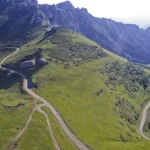
Jvari Monastery sits on the ridge above the confluence, a 6th-century church that is one of the oldest surviving examples of Georgian ecclesiastical architecture. The walk up takes around 30 to 40 minutes from the lower road, or taxis regularly make the short drive. On festival day, Jvari also draws pilgrims, but the crowds are lighter than at Svetitskhoveli. The view from the terrace — looking down at the river junction and across to the city — is among the most recognisable landscapes in Georgia, and in October’s clear air it is at its sharpest.
Samtavro Monastery, a short walk from Svetitskhoveli within the old city, is the site of Saint Nino’s original garden and the burial place of King Mirian III and Queen Nana, who converted Georgia to Christianity. It is a working nunnery and a quieter, more contemplative counterpoint to the main festival crowds. The interior is small and dark, lit almost entirely by candles, and the smell of beeswax and old stone is immediate and strong the moment you step inside.
If you have time, the Archaeological Museum of Mtskheta holds finds from the nearby Armaztsikhe-Bagineti fortress site — a largely overlooked collection that gives real context to how old and layered this city actually is.
Getting to Mtskheta from Tbilisi in October 2026
Mtskheta is straightforward to reach under normal conditions. On Mtskhetoba, normal conditions do not apply.
The most reliable option is the suburban train from Tbilisi’s central station. Trains run regularly and take around 20 minutes. On festival day in past years, Georgian Railway has added extra services on this route in the morning and afternoon — check the current schedule closer to the date at the Georgian Railway website or at the station information desk. The train drops you a short walk from the old city.
Marshrutkas depart from Didube station in Tbilisi (reachable via Tbilisi Metro) and run frequently, costing around 1–2 GEL per person. On festival day the minibuses fill fast. Expect standing room and a slightly chaotic departure zone — it works, but it requires patience.
Taxis and ride apps (Bolt and Yandex both operate the Tbilisi–Mtskheta route) are comfortable but significantly slower on festival day due to traffic on the main highway. If you are in a group of three or four, splitting the fare makes this reasonable. Budget around 25–40 GEL each way depending on demand surge pricing on the day.
Driving yourself and parking in Mtskheta on festival day is genuinely difficult. If you have a rental car, park at the edge of the city and walk in.
2026 Budget Reality: What to Expect to Spend
Entry to Svetitskhoveli Cathedral, Jvari, and Samtavro carries no mandatory ticket fee — these are active religious sites. Donations are welcomed and culturally appropriate. The Archaeological Museum charges a small entry fee; expect around 5–10 GEL per adult.
- Budget tier: Transport by marshrutka both ways (4 GEL total), street food from vendors — churchkhela, bread, grilled meat skewers — 15–25 GEL, water and soft drinks 5 GEL. Full day around 25–35 GEL per person.
- Mid-range tier: Taxi or ride app both ways (50–80 GEL total for a couple), sit-down lunch at one of the restaurants near the cathedral — expect 30–50 GEL per person for a full Georgian spread with wine. Total day around 80–130 GEL per person.
- Comfortable tier: Private transfer from Tbilisi (150–200 GEL return for the vehicle), lunch at a better-regarded restaurant in the old city with wine and dessert (60–90 GEL per person), guided tour if arranged in advance (100–200 GEL depending on the guide). Full day 300–490 GEL for two people.
Restaurant prices in Mtskheta have increased noticeably since 2024, reflecting both inflation and the growth in tourist traffic. A simple lunch that cost 20 GEL per head two years ago is now more likely to be 30–35 GEL. This is still excellent value by most international standards, but it is no longer the bargain it once was.
Practical Logistics: What to Wear and How to Behave
October in Mtskheta means temperatures of roughly 12–18°C during the day, often dropping sharply after 17:00. A light jacket or mid-layer is essential, particularly if you are staying for the evening. The ground in the cathedral courtyard is uneven stone — flat-soled, comfortable shoes are a practical necessity.
Photography inside active churches is a sensitive area in Georgia. At Svetitskhoveli on festival day, with a packed congregation mid-liturgy, pointing a camera at worshippers is genuinely inappropriate. Photograph the architecture freely from outside; be discreet and respectful inside.
Frequently Asked Questions
When exactly is Mtskhetoba in 2026?
Mtskhetoba falls on the first Sunday of October each year. In 2026, that is 4 October. The main liturgy at Svetitskhoveli Cathedral begins early in the morning, typically before 9:00, and the celebrations continue informally through the afternoon and into the evening.
Is Mtskhetoba only for Georgian Orthodox Christians, or can anyone attend?
Anyone is welcome to attend. Mtskhetoba is a public celebration and Mtskheta itself is an open city. Non-Christian visitors attend every year. Respectful behaviour and appropriate dress are expected inside the churches and in the cathedral courtyard during religious services. No prior arrangement or invitation is needed.
How long should I plan to spend in Mtskheta on festival day?
A full day — roughly 8:00 to 17:00 — is the right plan if you want to experience both the morning liturgy atmosphere and the afternoon festival mood, plus visits to Jvari and Samtavro. A half-day from midday works if your main interest is the cultural and social atmosphere rather than the religious programme.
Is Mtskheta worth visiting in October outside of the festival weekend?
Yes, genuinely. October is one of the best months to visit Mtskheta regardless of the festival. The autumn light is exceptional, the crowds are smaller than in summer, the surrounding landscape is beginning to colour, and the city’s sites — Svetitskhoveli, Jvari, Samtavro — are all fully accessible. Any weekend in October is a good choice.
Are there accommodation options in Mtskheta itself, or is it better to stay in Tbilisi?
Most visitors stay in Tbilisi and make the day trip, which is easy given the proximity. Mtskheta does have guesthouses and small hotels, and staying overnight gives you the city in the evening quiet after the festival crowds have left — a genuinely different and worthwhile experience. Book well in advance for the festival weekend, as accommodation fills quickly in 2026.
Explore more
Relax and Rejuvenate: Georgia’s Sulphur Baths in September 2026
Ideal Sightseeing: Exploring Georgia’s Historic Gems This September 2026
September 2026 in Georgia: Autumn Colors and Cooler Days