Before You Read: A 2026 Reality Check
In 2026, Georgian polyphonic singing has become something of a bucket-list item for cultural travellers — which means there is now a flood of staged “folk shows” at tourist restaurants that bear almost no resemblance to the real thing. If you arrived expecting monks in candlelit churches or farmers singing in perfect three-part harmony over a long table of wine, you may have already been disappointed by a hotel lobby performance. This guide cuts through that. It explains what polyphony actually is, where it genuinely survives, and how to encounter it with some respect for what it means to Georgians themselves.
What Georgian Polyphonic Singing Actually Is
Polyphony means multiple independent vocal lines performed simultaneously — not one melody with harmonies stacked underneath it, but three (and sometimes more) fully separate melodies that weave together. Georgian polyphony takes this further than almost any other vocal tradition on earth. The three voices — called mtkavari (the lead), modzakhili (the response voice), and bani (the bass drone) — are not following each other. They are arguing, agreeing, and resolving tension in real time.
What makes this unsettling for Western ears at first is the use of dissonance. Georgian singers regularly hold what European music theory would call a second — two notes just a step apart — sustained and resolved in ways that feel ancient. When you first hear it in a live, unamplifed setting, the sound has a physical quality. The overtones produced when three voices intersect in a stone church or a low-ceilinged room create a fourth “ghost” sound — a natural acoustic phenomenon that experienced singers actively shape. Standing inside that sound is nothing like watching it on a screen.
There is no conductor. No written score. The songs are learned orally, held in memory across generations, and performed from memory. The lead singer typically begins and the other voices join in, adjusting to each other in real time. This requires singers who have grown up hearing and absorbing the tradition — you cannot learn it in a weekend workshop, though you can begin to understand its structure.
Where It Came From
Georgian polyphony predates Christianity in Georgia. The oldest layers of the tradition — particularly work songs, hunting songs, and ritual songs tied to agricultural cycles — are believed to be over 1,500 years old, possibly significantly older. When Christianity arrived in Georgia in the 4th century, the church did not suppress these existing vocal traditions. Instead, Georgian sacred music absorbed and adapted them. The result is a sacred choral tradition that sounds unlike any other Christian music in the world — the Byzantine framework was modified by Georgians into something distinctly their own.

This dual origin matters. It explains why Georgian polyphony covers such a vast emotional and functional range — from table songs (застольные in Russian, or застольные სიმღერები in Georgian context) to funeral laments, from nature hymns to warrior songs. The tradition was not invented for church or court. It grew from people working fields, hunting mountains, drinking wine, and burying their dead. That rootedness is why it has survived.
Soviet-era ethnomusicologists in the 20th century documented thousands of polyphonic songs before some regional singers passed away, creating archives now held in Tbilisi. Some of these recordings were used in the 1977 NASA Voyager Golden Record — Georgian polyphony was selected as one of humanity’s musical offerings to the cosmos. That is not a piece of trivia. It is a measure of how singular this tradition sounds to anyone who encounters it with open ears.
The Three Regional Styles
Georgian polyphony is not monolithic. Three major regional styles exist, and they sound genuinely different from one another.
Kartl-Kakheti (Eastern Georgia)
This is the style most associated with Georgian table songs — the застольные or feast songs. The texture is relatively smooth, the harmonies are rich and rounded, and the bass voice provides a stable foundation. Songs like Mravalzhamier (a toast song wishing long life) come from this tradition. If you attend a supra in eastern Georgia, this is what you are likely to hear. The style is sometimes described as the most “accessible” to outside ears because the dissonance is more resolved and the melodic lines are easier to follow.
Svaneti (Northwestern Highlands)
Svan polyphony is the most archaic-sounding of the three. Svaneti is Georgia’s most geographically isolated region — high mountain villages only regularly accessible for much of history during summer months — and its music reflects that isolation. The harmonies are starker, the drone more prominent, and the dissonance held longer and more intensely. Svan songs include ancient ritual pieces tied to pre-Christian mountain deities that were never fully replaced by Christian equivalents. Hearing Svan polyphony is genuinely disorienting the first time — it sounds older than history in a way that is hard to articulate.
Guria (Western Georgia)
Gurian polyphony is the most technically daring. It is famous for the krimanchuli — a falsetto yodel-like upper voice that shoots above the main melody in sudden, sharp ornaments. Gurian table songs and harvest songs use this technique with startling precision. The style is rhythmically more complex than Kartl-Kakheti singing, and the interplay between voices is faster and more unpredictable. Many professional Georgian ensembles who tour internationally are performing Gurian repertoire because its energy translates well to stage settings.

The Supra Connection
You cannot fully understand Georgian polyphony without understanding the supra — the formal Georgian feast. The supra is not a dinner party. It is a structured social ritual presided over by a tamada (toastmaster), and singing is not entertainment that happens alongside it. Singing is woven into the architecture of the feast itself.
After certain toasts — particularly Mravalzhamier — the table sings together. This is not optional, and it is not performative. Every Georgian at that table knows the parts and sings them. Men typically carry the vocal lines, though this varies by region and context. The tamada initiates, the table responds. The song functions as a collective affirmation of the toast’s meaning — it seals the sentiment in sound.
For a foreign guest at a supra, the protocol is straightforward: listen, do not talk over the singing, and do not film conspicuously during intimate moments. If you are invited to attempt a word or a hum along, that is a gesture of inclusion — accept it graciously even if you produce nothing resembling the right notes. Georgians are not precious about foreigners participating imperfectly. They are precious about sincerity.
UNESCO Recognition and Why It Matters in 2026
Georgian polyphonic singing was inscribed on UNESCO’s Intangible Cultural Heritage list in 2001 — one of the first traditions to receive this recognition globally. In the years since, this status has had a complicated practical effect. On the positive side, it brought funding for documentation, encouraged younger Georgians to study the tradition, and created international touring opportunities for ensembles. The Rustavi Choir, the Ensemble Basiani, and others have performed on stages across Europe, Asia, and North America.

The complication is the same one that follows any “heritage-listed” living tradition: it risks becoming a museum piece. In 2026, there is an active and sometimes tense conversation inside Georgia about the difference between preserving polyphony and commercialising it. Some singers and ethnomusicologists argue that the growth of polyphony tourism — particularly staged performances sold as packages to tour groups — strips the music of its social function and turns it into a product.
This is not a reason to avoid engaging with polyphony. It is a reason to engage with it carefully. A village church choir singing before a liturgy is not the same thing as a dinner show. Both can be moving experiences, but they are not equivalent, and Georgians know the difference even if visitors do not.
How to Experience It as a Visitor
There is a spectrum of access, and your approach should match your intentions.
- Orthodox church services: Many Georgian Orthodox churches use polyphonic chant in their liturgies, particularly on Sundays and feast days. Dress appropriately — women cover their heads and shoulders, men remove hats. Arrive quietly, stand near the back, and do not move around during the singing. This is worship, not a performance. The sound of a trained choir in a stone church, the beeswax candles and incense layering the air, is genuinely unlike anything you can replicate in a concert hall.
- Folk ensembles in formal concert settings: Tbilisi’s Philharmonic Hall and the Small Concert Hall regularly host Georgian folk and polyphonic ensembles. These are professional performances in a respectful setting — appropriate for someone who wants to hear the music with full attention. Check the State Concert Hall schedule in advance.
- Cultural festivals: The Art-Gene Festival (usually held in June in Tbilisi’s Open Air Museum of Ethnography) brings together regional folk groups including polyphonic singers from different parts of Georgia. In 2026, this remains one of the most accessible ways to hear multiple regional styles in one setting without a purely commercial framing.
- Workshops: Several cultural organisations in Tbilisi offer short introductory workshops on Georgian vocal tradition. These are not designed to make you a polyphonic singer. They are designed to help you hear and understand the structure. One session of learning even the bani drone part gives you a completely different relationship to the music you then hear live.
2026 Budget Reality
The cost of experiencing Georgian polyphony varies enormously depending on the context.

Budget
- Church liturgy: Free — no ticket, no booking required
- Art-Gene Festival general admission: 15–25 GEL
- Open-air cultural events in public spaces: Free to 10 GEL
Mid-Range
- Philharmonic Hall or Small Concert Hall tickets for folk/polyphony performances: 35–80 GEL
- Introductory vocal workshop (2–3 hours, organised by cultural centres): 60–100 GEL per person
- Guided ethnomusicology walking tour covering polyphony history and a live demonstration: 80–120 GEL
Comfortable
- Private masterclass or extended workshop with professional ensemble members: 200–400 GEL
- Curated cultural experience including supra with authentic singing (not a tourist dinner show): 300–500 GEL per person — these exist but require local contacts or specialist cultural tour operators to arrange properly
Avoid anything marketed as a “Georgian folk dinner show” at a flat rate that seems to include everything. In 2026, these have proliferated and the singing component is typically rushed, amplified in ways that destroy the acoustic properties of the tradition, and performed by singers who may not be specialists in the form.
Frequently Asked Questions
Is Georgian polyphonic singing only for men?
Traditionally, many polyphonic forms — particularly table songs — were male-dominated. Women’s polyphony exists and is well-documented, especially in Svaneti and Guria, but social contexts varied by region. In 2026, mixed and all-female ensembles perform professionally, and this is not considered unusual or controversial in contemporary Georgian cultural life.
Do I need to know anything about music to appreciate polyphony?
No formal music knowledge is needed. The dissonance can feel unusual at first, but listening to two or three recordings before attending a live performance helps your ear adjust. Understanding that three voices are doing different things simultaneously — rather than following one melody — is the only framework you genuinely need.
Can foreigners participate in polyphonic singing at a supra?
You will not be expected to know the parts. If the table sings, you are welcome to hum, clap gently, or simply listen respectfully. Georgians appreciate genuine engagement far more than technical ability. Attempting even a word or two of the lyric is received warmly. Sitting silently on your phone is the only real social misstep.
Is Georgian polyphony related to other Caucasian music traditions?
Georgian polyphony is specific to Georgia and represents its own tradition. While neighbouring cultures — Armenian, Azerbaijani, and various North Caucasian peoples — have rich musical traditions, Georgian polyphony’s three-voice independent-line structure is not shared by them. The Kartvelian language family is itself unrelated to any other language group, and the music shares that sense of standing completely alone.
When is the best time to hear polyphonic singing in Georgia?
October is the strongest month: Tbilisoba festival, the tail end of Rtveli harvest season in Kakheti, and the peak of the cultural performance calendar all overlap. January 7th (Orthodox Christmas) and Easter are also exceptional for church choral music. The Art-Gene Festival in June is the best summer option for hearing multiple regional styles in one accessible setting.
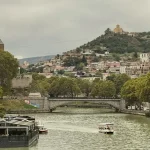
📷 Featured image by Jessica Furtney on Unsplash.