On this page
- Georgia’s Three Mobile Operators — Who They Are and What They Offer
- Where to Buy a SIM Card in Georgia (And Where Not To)
- Step-by-Step: Buying and Activating a SIM at Tbilisi Airport
- eSIM Activation — How It Works and Which Phones Are Compatible
- Tourist SIM Packages — 2026 Budget Reality and What You Actually Get
- Mobile Coverage in the Mountains — Kazbegi, Svaneti, and Beyond
- Managing Your SIM — Topping Up, Checking Balance, and Using Operator Apps
- Wi-Fi in Georgia — When You Can Rely on It and When You Can’t
- Common Mistakes Tourists Make with Georgian SIM Cards
- Frequently Asked Questions
Getting online the moment you land in Georgia sounds simple, but plenty of tourists in 2026 still arrive at Tbilisi airport, walk past the SIM kiosks without stopping, and spend their first two days fumbling with patchy hotel Wi-Fi, trying to hail a Bolt taxi they cannot load, or navigating with a downloaded map that was last updated three months ago. A local SIM card or an eSIM solves all of that in under fifteen minutes. This guide covers exactly what to buy, from which operator, at what price, and what to realistically expect when you head into Georgia’s mountains.
Georgia’s Three Mobile Operators — Who They Are and What They Offer
Georgia’s mobile market in 2026 runs on three operators. Understanding the difference between them saves you from buyer’s remorse after you’ve already activated a SIM that drops signal the moment you leave Tbilisi.
MagtiCom (Magti)
Magti is Georgia’s largest operator and holds the strongest reputation for coverage outside the cities. If you plan to visit Kazbegi, Svaneti, Tusheti, or any other mountainous region, Magti is consistently recommended by travellers and locals alike. Their network reaches into valleys and along mountain roads where the other two operators struggle. Their official website is magticom.ge and their app is called MyMagti, available on both iOS and Android.
Silknet (formerly Geocell)
Silknet completed its full absorption of the old Geocell brand by 2026. If you used Geocell on a previous trip to Georgia before 2024, that brand is gone — everything now operates under the Silknet name. The website geocell.ge redirects to silknet.com, and the app is called MySilknet. Coverage in cities and major towns is solid, and Silknet’s tourist packages tend to be slightly cheaper than Magti’s. In remote mountain areas, though, the signal is less reliable than Magti.
Beeline (VimpelCom Georgia)
Beeline sits in third place on both coverage and market share. Their website is beeline.ge and their app is MyBeeline. They compete primarily on price for city travellers. If your trip is largely Tbilisi, Batumi, and Kutaisi — with no deep mountain detours — Beeline can offer reasonable value. Step into serious backcountry, however, and you will notice the coverage gaps quickly.

Where to Buy a SIM Card in Georgia (And Where Not To)
The short answer: buy directly from an official kiosk or store. The longer answer involves a few options depending on when and where you arrive.
Tbilisi International Airport (Shota Rustaveli TBS)
This is the best place to buy your SIM. All three operators — Magti, Silknet, and Beeline — have kiosks in the arrivals hall, positioned after you exit customs and baggage claim. They are easy to spot, usually lined up next to each other. Kiosks operate 24 hours or during peak flight arrival windows. Staff speak basic to decent English. You can buy a physical SIM or activate an eSIM here without needing to go anywhere else.
Official Operator Stores in Cities
Every major city has official branded stores: Tbilisi has numerous Magti, Silknet, and Beeline outlets, and Batumi and Kutaisi each have several branches. Staff in city stores often speak better English than airport kiosk staff, and they have more time to walk you through plan options. If you arrive late at night and bypass the airport kiosks, a city store the following morning is your best alternative.
Authorized Resellers and Small Shops
Small phone shops and corner stores occasionally sell SIM cards, but stick to official sources. The registration process in Georgia requires linking your passport to your SIM — it is a legal requirement, not optional. Unauthorized sellers do not always complete this properly, which can cause your SIM to be deactivated. It is not worth the risk for the sake of convenience.

Batumi International Airport
Batumi airport also has operator kiosks in arrivals, though the selection and staffing hours are less consistent than Tbilisi. If you arrive via Batumi, check whether the kiosks are open when you land. If not, head into the city — Batumi’s main shopping streets have official stores within a short taxi ride.
Step-by-Step: Buying and Activating a SIM at Tbilisi Airport
The process is straightforward, but knowing what to expect means you won’t be the person holding up the queue trying to find their passport at the bottom of a carry-on bag.
- Exit customs and baggage claim. The operator kiosks are immediately visible in the arrivals hall. All three operators are present, usually within a few metres of each other.
- Choose your operator. For most tourists, especially those planning mountain travel, Magti is the default recommendation. If budget is the priority and your trip stays urban, Silknet or Beeline offer lower entry-level prices.
- Present your passport. A physical passport is mandatory. Staff will take a copy or scan it. This step cannot be skipped — it is a regulatory requirement in Georgia for all SIM registrations.
- Select a plan. Tell the staff your trip length and whether you need calls or just data. They will suggest appropriate tourist packages. If you want a specific package you have researched in advance, name it directly.
- Pay in GEL. Both cash and card payments are accepted at airport kiosks. The SIM card itself costs around 5 GEL, and this fee is often bundled into the tourist package price.
- Insert the SIM or scan the QR code for eSIM. For a physical SIM, staff will check your phone’s SIM tray size and cut the card if needed. For eSIM, they provide a QR code — you go to your phone’s Settings, find the option to add a mobile or data plan, and scan the code. Use the airport’s Wi-Fi for the initial profile download if your phone has no existing data connection.
- Test the connection. Staff will typically check that the SIM or eSIM is active before you walk away. Open a browser or let them ping your number to confirm it is live.

During peak hours — after wide-body international flight arrivals from Istanbul, Dubai, or Warsaw — each kiosk queue can run 15 to 30 minutes. Off-peak, the whole process from queue to working SIM takes under ten minutes.
eSIM Activation — How It Works and Which Phones Are Compatible
eSIM use among tourists visiting Georgia has grown significantly since 2024. All three operators now offer eSIM activation at their airport kiosks and official stores, with clearer processes and English-speaking staff trained to handle it.
An eSIM is a digital SIM profile stored inside your phone. There is no physical card to insert. This is useful if you want to keep your home SIM active in the second physical slot while using a Georgian number for data — dual-SIM operation. It also removes the risk of losing a tiny physical SIM card somewhere in a guesthouse in Mestia.
Compatible Devices
Most flagship smartphones released from 2020 onwards support eSIM: iPhone XS and later, Google Pixel 3 and later, Samsung Galaxy S20 and later, and many other Android devices. Check your phone’s spec sheet or go to Settings and search for “eSIM” or “Add Mobile Plan” before you travel. Note that some phones sold in China or certain Asian markets have eSIM functionality disabled by the manufacturer — check this in advance.

One Important Limitation
Once a QR code for an eSIM is scanned and the profile is activated, that QR code is used up. If you scan it and then delete the profile — or factory reset your phone — you cannot simply scan the same code again. You would need to return to an operator store for a new QR code. Handle the activation carefully the first time.
Tourist SIM Packages — 2026 Budget Reality and What You Actually Get
Prices below reflect 2026 figures. There has been a general increase of around 5 to 10 percent compared to 2024 packages, with operators partially offsetting this through slightly larger data allowances.
Magti Tourist Packages
- Budget: Standard prepaid SIM with a 5 GB internet package — approximately 15 GEL
- Mid-range (Tourist Welcome Pack): 10–15 GB data, 100–200 local call minutes, 50–100 SMS, 30-day validity — approximately 35–40 GEL
- Comfortable: 20 GB data package or 7-day unlimited data add-on — approximately 35 GEL for 20 GB, or 15 GEL for 7-day unlimited
Silknet Tourist Packages
- Budget: Basic data bundle — 7-day unlimited internet for approximately 12 GEL
- Mid-range (Tourist Pack): 8–12 GB data, 50–100 local call minutes, 50 SMS, 15–30 day validity — approximately 28–32 GEL
- Comfortable: Larger data bundle with extended validity — check silknet.com for current 30-day options
Beeline Tourist Packages
- Budget: Entry-level data package — approximately 10–15 GEL for basic data and limited calls
- Mid-range (“Hello Georgia” or equivalent): 7–10 GB data, 30–50 local call minutes, 30 SMS, 15–30 day validity — approximately 20–25 GEL
- Comfortable: Higher-data prepaid option — check beeline.ge for current offerings
For a two-week trip with moderate data use — Google Maps, messaging apps, occasional video calls, social media — a mid-range tourist package from any operator is sufficient. Heavy streamers or remote workers should look at the unlimited daily options or larger data bundles. All three operators sell extra data top-ups through their apps if you burn through your allowance mid-trip.

Mobile Coverage in the Mountains — Kazbegi, Svaneti, and Beyond
Georgia’s mountain regions are the reason many tourists come here, and they are also where mobile coverage gets genuinely unpredictable. Understanding the gaps before you leave Tbilisi matters — not just for Instagram, but for safety when navigating unfamiliar trails.
Kazbegi (Stepantsminda)
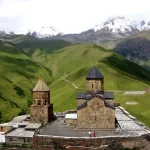
The town of Stepantsminda itself has reliable Magti coverage. Standing at the base of the trail leading up to Gergeti Trinity Church — that iconic stone church perched above the Terek valley with Mkinvartsveri behind it — you will almost certainly have a signal. As you climb higher or move into the side valleys, coverage becomes intermittent. Magti performs best here; Silknet is workable in the town; Beeline is acceptable in Stepantsminda but weakens noticeably on trails.
Svaneti (Mestia and Ushguli)
Mestia has solid Magti coverage. The drive from Zugdidi to Mestia along the Enguri Gorge passes through several dead zones regardless of operator, so do not rely on live navigation for that stretch — download the route offline in advance. Ushguli, one of the highest permanently inhabited villages in Europe, has limited but functional Magti signal in the village centre. Push further into the surrounding highlands and all bets are off.
Tusheti and Other Remote Regions
Tusheti is genuinely remote. The Abano Pass road — which is only open from roughly late May to early October — takes you through terrain where signal disappears for long stretches. Magti gives you the best chance, but even Magti users should treat connectivity as a bonus rather than a given in Tusheti. Carry a physical paper map or a fully offline digital map loaded before departure.

The practical takeaway: download Google Maps or Maps.me offline maps for every region you plan to visit before leaving a city. This is not optional advice for mountain travel — it is basic preparation.
Managing Your SIM — Topping Up, Checking Balance, and Using Operator Apps
Once your SIM is active, managing it is straightforward if you know where to look. All three operators have functional apps that handle the most common tasks without requiring a trip to a store.
Operator Apps
Download your operator’s app before or immediately after activation:
- MyMagti (magticom.ge app): Check data balance, activate new packages, top up credit, view usage history. The interface is available in Georgian and English.
- MySilknet (silknet.com app): Same core functions. English-language support has improved since 2024.
- MyBeeline (beeline.ge app): Balance checking, package activation, top-up. English interface available.
Topping Up Without the App
If you prefer not to use an app, top-up options are everywhere. Most supermarkets in Georgia — including Carrefour, Goodwill, and Spar branches — have payment terminals that accept mobile top-ups. Small convenience stores (typically displaying operator logos in the window) also sell scratch-card top-up vouchers or process direct top-ups at the counter. Tell the cashier your number and the amount you want to load.
Checking Your Balance by Dialling
Each operator has a short USSD code you can dial to check your balance without an app or internet connection:
- Magti: Dial *100#
- Silknet: Dial *100# or check via MySilknet
- Beeline: Dial *102#
Confirm the exact code with staff at the point of purchase, as USSD codes occasionally change.
Wi-Fi in Georgia — When You Can Rely on It and When You Can’t
Wi-Fi in Georgia is genuinely good in most urban settings — but there are specific situations where it will let you down, and those situations often overlap with exactly the moments you need connectivity most.

Cafés, Restaurants, and Accommodation
The smell of freshly brewed coffee and the warmth of a Tbilisi café in winter come standard with a decent Wi-Fi password written on a chalkboard by the counter. Free Wi-Fi is near-universal in Georgian cafés, restaurants, and bars. Hotels, guesthouses, and hostels all provide it as a standard amenity. Most guesthouses in mountain towns like Mestia and Stepantsminda also offer Wi-Fi, though speeds can be slow during evenings when multiple guests are online simultaneously.
Public Wi-Fi Networks
Tbilisi has a public Wi-Fi network — historically marketed under the “Tbilisi Loves You” branding — in parts of the city centre. In practice, these networks are unreliable and slow. They are not a substitute for a personal data connection. Use them only as a last resort to activate an eSIM or make a quick check if your SIM data runs out unexpectedly.
Georgian Railway Trains
The modern Stadler Kiss electric trains used on the Tbilisi–Batumi route offer onboard Wi-Fi. Connection quality varies — it works reasonably well across the Kolkhi lowlands but drops in tunnels and some mountain sections. Older rolling stock on other routes does not carry Wi-Fi. Do not plan to work remotely on a train journey without a backup data connection from your SIM.
Marshrutka Minibuses
Marshrutkas — the shared minibuses that form the backbone of intercity travel between smaller towns and villages — carry no Wi-Fi. If you are taking a marshrutka from Zugdidi to Mestia or from Tbilisi’s Didube station to Mtskheta, your SIM card is your only connectivity option for the entire journey.
Common Mistakes Tourists Make with Georgian SIM Cards

These are the errors that come up repeatedly, and most of them are entirely avoidable with a small amount of advance planning.
Choosing Beeline for a Mountain-Heavy Trip
Beeline’s pricing looks attractive, and it is fine for a Tbilisi-only visit. But tourists who choose it for coverage reasons and then spend a week in Svaneti often end up frustrated. If mountains are on your itinerary, buy Magti. The price difference between a Beeline and Magti tourist pack is typically 10 to 20 GEL — less than a single restaurant meal.
Not Checking eSIM Compatibility Before Travel
Arriving at the airport and discovering your phone does not support eSIM — when you were counting on it — means joining the physical SIM queue, which may be longer. Check your phone’s eSIM capability before you leave home. If your device supports it, the airport process is faster and you keep your home SIM active simultaneously.
Forgetting to Download Offline Maps
Even with a Magti SIM, mountain coverage is not guaranteed. Tourists who rely entirely on live Google Maps navigation and then lose signal on the Mestia–Ushguli road in rainy weather have genuinely gotten into difficulty. Download offline map data for every Georgian region you plan to visit while you are still on solid city Wi-Fi or 4G.
Buying a SIM from an Unauthorized Shop
Georgian law requires all SIM cards to be registered against a valid passport. Unauthorized sellers do not always complete this registration correctly. A SIM that is not properly registered can be deactivated by the operator, sometimes within days of purchase. The official airport kiosks and branded stores take two minutes longer but handle registration correctly every time.
Not Using the Operator App to Extend or Add Packages
Tourists often think their only option when they run out of data mid-trip is to find a store. The operator apps — MyMagti, MySilknet, MyBeeline — let you add data packages instantly from your phone, as long as you have enough GEL credit balance. Load a small amount of extra credit when you first buy your SIM so you have the option to self-serve if needed.

Assuming Hotel Wi-Fi Is Enough for Navigation
Hotel Wi-Fi gets you through the evening of planning, but the moment you step outside and need to find a street, hail a Bolt, or translate a sign in a village market — you need mobile data. Georgia’s cities are not difficult to navigate, but without a working data connection, small inconveniences become big ones quickly. The cost of a tourist SIM package is too low to justify relying on hotel Wi-Fi alone.
Frequently Asked Questions
Do I need my passport to buy a SIM card in Georgia?
Yes, a valid physical passport is mandatory for SIM card registration in Georgia. This is a legal requirement that applies to all three operators. Staff at airport kiosks and official stores will take a copy or scan of your passport and link it to your new number. Without it, you cannot complete the purchase.
Which Georgian mobile operator has the best coverage in the mountains?
Magti consistently provides the strongest coverage in Georgia’s mountainous regions, including Kazbegi, Svaneti, and Tusheti. Silknet works well in major mountain towns but weakens in remote valleys. Beeline is the least reliable outside urban areas. For any trip that includes serious mountain travel, Magti is the clear recommendation.
Can I activate a Georgian eSIM before I arrive in Georgia?
In 2026, all three operators require in-person registration at an official kiosk or store because SIM activation is tied to a passport check. You cannot fully activate a Georgian operator eSIM remotely from abroad. If you want connectivity the moment your flight lands, arrive ready to stop at the Tbilisi airport kiosk before exiting the arrivals hall.

How much should I budget for a tourist SIM card in Georgia in 2026?
Budget travellers can get a functional SIM with basic data for around 15–20 GEL. A mid-range tourist package covering a two-to-four-week trip with 8–15 GB of data and some local call minutes costs between 28 and 40 GEL depending on the operator. Magti’s tourist packs sit at the higher end; Beeline at the lower end.
Is Wi-Fi reliable enough in Georgia that I don’t need a SIM card?
For a strictly urban trip that stays in Tbilisi hotels and cafés, you could manage without one — but it is not comfortable. The moment you take a marshrutka, go hiking, or need a Bolt taxi in an unfamiliar neighbourhood, you will want mobile data. A tourist SIM costs between 20 and 40 GEL for the entire trip. That is too cheap a problem to leave unsolved.
📷 Featured image by Nick Osipov on Unsplash.